Quick answer: Marketers can use anonymous Instagram story viewers to monitor competitor campaign launches, promotional timing, creative testing, and message content without appearing on the competitor’s viewers list. This provides real-time insights into the marketing tactics of others and helps to optimize one’s own campaigns in terms of both timing and content.
Marketing teams that treat competitive intelligence monitoring as an ongoing process, rather than a one-time task, can benefit massively from it. And since the Instagram story format is one of the richest sources of information on competitors’ marketing activities, being able to consume it in real-time via an anonymous viewer grants serious advantages. Let’s take a closer look at how this competitive intelligence process can be integrated into the marketing operations of a business.
Overview: How To Use Instagram Story Viewers Anonymously To Monitor Competitors
Why Stories Reveal More Than Feed Posts for Campaign Tracking
Feed posts typically get more editing and refinement prior to publication and represent a brand's best and most considered thought. Stories, on the other hand, lend themselves to more promotional and tactical uses: flash sales, testing new campaigns, behind-the-scenes and insider stories regarding a product launch, as well as timely commentary on current events and issues of public interest.
In short, stories can be a great place to start in dissecting what your competitor is really up to since they tend to represent more of their day-to-day marketing activity than their more polished feed posts.
The Four Categories of Competitive Intelligence From Story Monitoring
Category 1
Campaign timing and cadence
Timing of a competitor’s promotional stories within a campaign, the frequency of promotional content across campaign vs. non-campaign periods, and the typical length of promotional bursts can signal a competitor’s planning cadence and help you time your own promotional messages to avoid direct message competition or counter-program.
Category 2
Creative and message testing
Competitors frequently use stories to test creative variations and message copy before broader use in feed or paid media. Tracking this activity can surface which angles a competitor is testing, and what (indirectly) appears to be working by virtue of being amplified later in a feed post or in a paid campaign.
Category 3
Pricing and promotional offers
Testimonials of discount code usage, limited-time offers, and pricing tests often appear first or exclusively on stories due to their time-constrained nature. Systematic tracking builds an archive of a competitor’s promotional pricing practices, illuminating their margins flexibility and general cadence of discounts.
Category 4
Partnership and collaboration activity
New partnerships, brand collaborations, and Collab posts are often first visible or most actively promoted in stories. Tracking this activity surfaces a competitor’s partnership strategies and the creator relationships they are prioritizing.
Building a Systematic Competitor Tracking Process
Setting Up Ongoing Competitive Story Monitoring
-
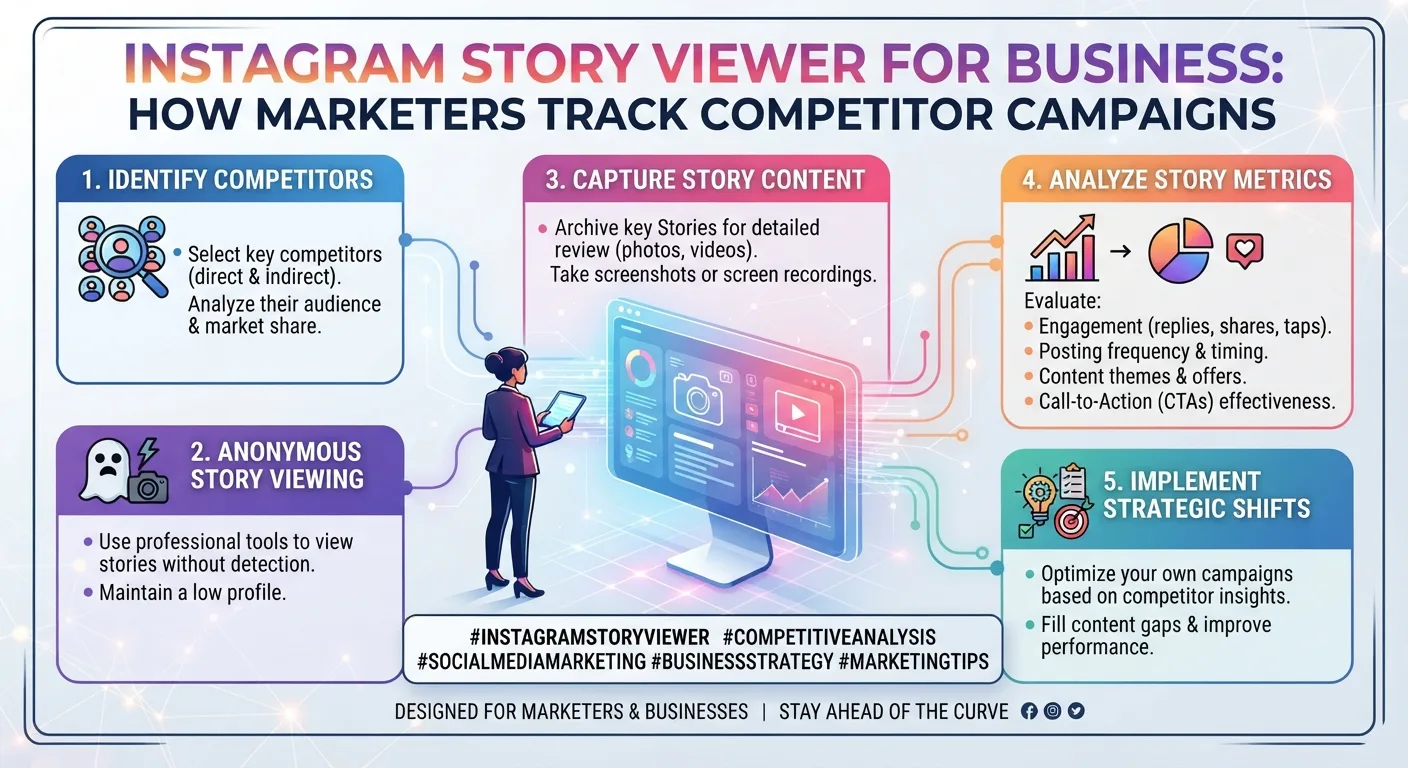
1Identify your own particular five to ten most direct competitors and rank them in terms of relevance to your business, giving priority to your top two or three for daily checks and less frequency for the rest
2Use an anonymous Instagram viewer to keep up with top-priority competitor stories on a daily basis, since stories disappear after 24 hours and cannot be saved later
3Keep all findings in one place, using a shared Excel file or Google sheet accessible for all team members which should be updated regularly and organized in tabs for different competitors, dates, or categories according to the four kinds of intelligence discussed above
4Schedule one weekly meeting where the findings would be discussed with the whole team, focusing on the comparison side of things and trying to find patterns between different competitors
5Use the intelligence data in campaigns toimprove the timing of your stories to better suit your audience plus experiment with different angles which other companies were not seen using
Why Anonymous Monitoring Matters for Marketing Teams Specifically
If a marketing team member’s professional account follows a direct competitor, the competitor’s marketing team would be aware of the follow and may become more careful in the type of story content they share in the future. In more aggressive industries, a competitor may even feel inclined to perform the same tactic against your team by monitoring your own accounts, leading to an endless cycle of unproductive research.
By using anonymous viewing tools, this concern is eliminated, as the competitive research done by your team would be completely undetectable, a necessary precaution that marketing professionals would be aware of when performing similar research on their own.
The compounding value of this type of strategy over time
is the most important aspect of this kind of research. One competitor observation is valuable, but a marketing team can only plan so far with one data point. Over the course of a few months, patterns begin to emerge with the content that competitors post, what type of campaigns they begin at certain times of the year, and what types of creative content they test before launching a full-fledged campaign. This type of insight can only come from this type of systematic, long-term analysis, as opposed to random observations, and is crucial in developing a competitive marketing strategy.
Key Takeaways
-
Instagram stories allow for seeing more subtle marketing tricks of competitors in a shorter period than regular feed posts.
I see four main types of value in analyzing the stories of our competitors: learning about the timing and frequency of their campaigns, getting insights on their creative and copy tests, discovering their pricing and promotional strategies, and finding out about their partnerships.
Following a system to keep track of stories on a daily basis will help you have an organized overview of what your competitors are doing and the changes they make.
By prioritizing the most relevant competitors and consistently reviewing their activity, you will not only get valuable marketing intelligence but also be able to share it within your team.
Since using Instagram stories to research competitors usually remains anonymous for both parties, it is a smart idea to utilize this method frequently and systematically throughout the month.
The value of such marketing intelligence will depend on how consistently you review your competitors’ activity.
Frequently Asked Questions
Is monitoring the story of the competitor a typical marketing practice?
Competitor monitoring, including social media, is a typical practice in the daily operations of most professional marketers. This way, most companies allow their marketing teams to track the publicly available information about their competitors’ stories on Instagram.
How many competitors can one person track in their stories?
In most cases, marketing teams only monitor five to ten directly competing businesses. Out of these, the top two to three are actively observed daily, while the others are checked weekly or when a relevant campaign launch is expected. If a company tracks more than ten social media stories, there is a high probability that they are not fully utilizing the collected information.
Can the whole team use one anonymous story viewer?
The majority of the anonymous Instagram story viewers are designed as standalone platforms. This means that the marketing team members can use the service independently without having to share a single user account and password. In most cases, teams also utilize the same secret story viewer due to the required level of competition intelligence.
What should a competitor intelligence document contain?
Most marketer agree that a competitor intelligence document should, at minimum, contain the observed date, competitor name, visual description or image of the observed Instagram story content, and the category it fell under. Additionally, many analysts add the level of relevance or importance and a separate section with the immediate implications and observations.
Does competitor story tracking replace other forms of competitive analysis?
Competitor analysis in marketing is not limited to monitoring the stories of one’s competitors. In most cases, companies conduct a complete scan of their competitors’ activities, including stories, regular social media feeds, advertisements (using the Meta Ad Library), pricing pages, and overall market presence.