Voice cloning technology has moved from a novelty demonstration to a practical production tool that a meaningful portion of Instagram creators now use in their regular workflow. The technology allows a short sample of someone's voice, sometimes as little as thirty seconds, to be used to generate new speech in that voice saying anything the creator types.
For Instagram Reel production specifically, this has opened up new content workflows that were not previously practical, alongside a set of ethical and platform policy considerations that every creator using the technology should understand.
How AI Voice Cloning Works for Reel Production
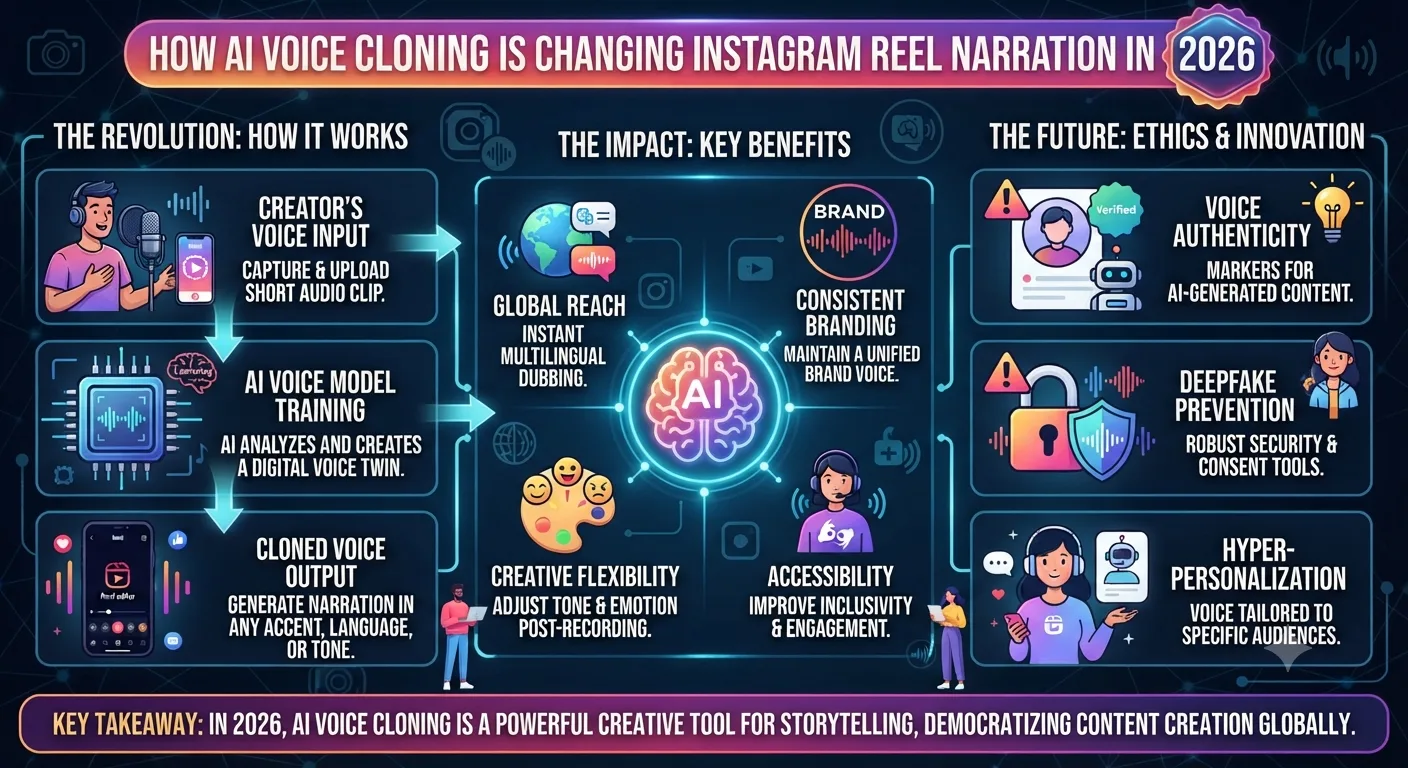
The process starts with a voice sample, typically several minutes of clean audio of the creator speaking naturally. This sample is processed by a voice cloning model that learns the specific characteristics of that voice: pitch, tone, pacing, and pronunciation patterns. Once trained, the model can generate new audio saying any text input in that learned voice.
For Reel production, this means a creator can write a script, generate the narration in their cloned voice without recording live, and pair it with visuals. This decouples the audio production from the physical act of recording, which changes the production workflow significantly.
The Three Main Use Cases for Creators in 2026
Batch Content Production
Creators who script a week or month of content in advance can generate all the narration audio in a single session without needing to record live for each individual piece. This is particularly valuable for creators managing multiple content pillars or working with a content team where the scripting and voice generation can happen asynchronously from the visual production.
Multilingual Content Expansion
Voice cloning combined with AI translation allows creators to produce the same Reel content in multiple languages while preserving their vocal identity. A creator's cloned voice can narrate a script translated into Spanish, French, or Mandarin, maintaining vocal consistency across markets that would be impossible if the creator does not actually speak those languages fluently.
This has enabled a meaningful expansion of audience reach for creators who choose to invest in multilingual content, since Instagram's global audience spans hundreds of language communities that most English-language creators never directly reach.
Faceless Account Voice Branding
Faceless Instagram accounts, which produce content without the creator appearing on camera, have historically relied on either text-only content or generic stock narration. Voice cloning allows a faceless creator to establish a consistent, recognizable vocal identity for their account, licensing or creating a distinctive synthetic voice that becomes part of their brand without ever revealing their face or real voice publicly.
The Leading Voice Cloning Tools for Instagram Creators
ElevenLabs remains the most widely used voice cloning platform among Instagram creators in 2026, known for the naturalness of its generated speech and its multilingual capability that preserves vocal characteristics across language translations. Its Instant Voice Cloning feature requires only a short sample and produces usable results within minutes.
Descript's Overdub feature integrates voice cloning directly into a video editing workflow, allowing creators to fix mistakes in recorded narration by typing corrections rather than re-recording, and to generate entirely new narration from text for content that was never recorded live.
Resemble AI and Play.ht are additional options with strong API access for creators building automated content pipelines that generate narration programmatically as part of a larger content production system.
The Ethical and Disclosure Considerations
Voice cloning of your own voice for your own content carries minimal ethical complexity since you are the rights holder generating content in your own likeness. The considerations become more significant in a few specific scenarios.
| Scenario | Ethical Status | Consideration |
|---|---|---|
| Cloning your own voice for your own content | Generally acceptable | Disclosure to audience is a growing best practice even when technically permissible |
| Cloning a licensed synthetic voice actor's voice | Acceptable with licensing | Ensure the platform's licensing terms permit commercial Instagram content use |
| Cloning another real person's voice with permission | Acceptable with documented consent | Written consent and disclosure to audience are strongly recommended |
| Cloning a public figure's voice without permission | Legally and ethically problematic | Right of publicity laws in most jurisdictions restrict this use, especially for commercial content |
| Cloning a voice to impersonate someone deceptively | Illegal in most jurisdictions | Fraud, defamation, and impersonation laws apply regardless of the technology used |
Practical Workflow for Adding Voice Cloning to Your Content Production
Setting Up a Voice Cloning Workflow
- 1Record a clean, high-quality voice sample of at least two to three minutes speaking naturally in a quiet environment with no background noise.
- 2Upload the sample to your chosen voice cloning platform and generate your voice model, which typically takes a few minutes to process.
- 3Write your Reel script separately from the recording process, allowing you to batch-write a week or month of scripts in one focused session.
- 4Generate the narration audio for each script using your cloned voice, reviewing each output for naturalness and making script adjustments if certain phrasing sounds unnatural when generated.
- 5Pair the generated audio with your visual content in your standard video editing workflow, and include appropriate AI disclosure per Instagram's current content policy.
Key Takeaways
- AI voice cloning allows creators to generate Reel narration in their own or a licensed voice without recording live audio for every piece of content.
- The three primary creator use cases are batch content production, multilingual content expansion, and voice branding for faceless accounts.
- ElevenLabs, Descript's Overdub, Resemble AI, and Play.ht are the leading voice cloning tools used by Instagram creators in 2026.
- Cloning your own voice or a properly licensed voice for your own content is ethically straightforward. Cloning someone else's voice without documented consent carries significant legal and ethical risk.
- Instagram's expanding AI content labeling policy increasingly covers synthetic audio narration, making disclosure an important practice for creators using this technology.
- Decoupling script writing from audio recording enables batch production workflows that significantly increase content output capacity for creators managing high-volume content calendars.
Frequently Asked Questions
Is it legal to clone your own voice for Instagram Reels?
Yes. Cloning your own voice for your own content is legally straightforward since you hold the rights to your own likeness and voice. The main consideration is disclosure to your audience about the use of AI-generated narration, which is increasingly expected as a best practice even where not strictly legally required.
Do I need to disclose that a Reel uses AI voice cloning?
Instagram's expanding AI content policy increasingly requires disclosure of AI-generated audio for certain content categories, and platform requirements continue to evolve. Beyond platform requirements, disclosing AI narration use is a transparency practice that helps maintain audience trust, particularly for informational or commercial content where authenticity matters to the audience relationship.
How much voice sample audio do I need to clone my voice?
Most leading tools including ElevenLabs can produce usable results from as little as thirty seconds of clean audio, though two to three minutes of varied speech produces noticeably more natural and versatile results. Longer, higher-quality samples with varied intonation generally produce better cloned output across different types of content and emotional tones.
Can AI voice cloning translate my content into other languages while keeping my voice?
Yes. Tools like ElevenLabs combine voice cloning with translation capabilities, allowing your cloned voice to narrate content in languages you may not personally speak. This has become a significant tool for creators looking to expand into international markets while maintaining vocal brand consistency across languages.
Is it illegal to clone someone else's voice for Instagram content?
Cloning another real person's voice without their documented consent is legally risky under right of publicity laws in most jurisdictions, particularly for commercial content. Cloning a public figure's voice without permission for content that could be mistaken for their genuine statements carries significant legal exposure and violates most platforms' policies against deceptive synthetic media, regardless of the creative intent behind it.