Personalization at scale used to require either a large content team or accepting that most audience segments would receive generic, one-size-fits-all content. AI has changed this economic equation. A single strategic brief can now generate dozens of tailored variations, each speaking directly to a specific audience segment's interests, location, or behavior, in a fraction of the time and cost that manual production would require.
Here is how brands are actually implementing this in 2026, the specific tools involved, and what the real-world applications look like across different business types.
What Personalization at Scale Actually Means
Personalized story generation does not mean writing one story per individual customer. It means creating meaningful audience segments, whether by geography, purchase history, engagement behavior, or demographic data, and generating distinct story variations tailored to each segment's specific context and interests.
A retail brand might segment its audience by past purchase category and generate story variations that lead with different products for each segment. A fitness brand might segment by engagement level and generate different messaging for highly engaged members versus lapsed followers. The AI layer generates the variations efficiently once the segmentation logic and creative brief are defined.
The Three Approaches Brands Use
Approach 1: Geographic and Cultural Personalization
Brands with multi-region audiences use AI to generate story content adapted for local language, cultural context, and regional relevance from a single core creative concept. A single campaign brief produces story variations for different markets that feel locally authentic rather than obviously translated, addressing local holidays, references, and purchasing patterns specific to each region.
Approach 2: Behavioral Segment Personalization
Using customer data such as past purchases, browsing history, and engagement level, brands generate distinct story sequences for different behavioral segments. A customer who has purchased before sees stories emphasizing new arrivals and loyalty rewards, while a customer who has only browsed sees stories addressing common objections and first-purchase incentives.
Approach 3: Dynamic Product Recommendation Stories
E-commerce brands connect AI story generation to their product catalog and customer data, generating story content that showcases specific products aligned with an individual's browsing or purchase history. This mirrors the personalization logic of email marketing but applied to the story format, using AI to generate the visual and text elements dynamically rather than manually producing each variant.
The Technical Workflow Behind AI Personalized Stories
How the Personalized Story Generation Process Works
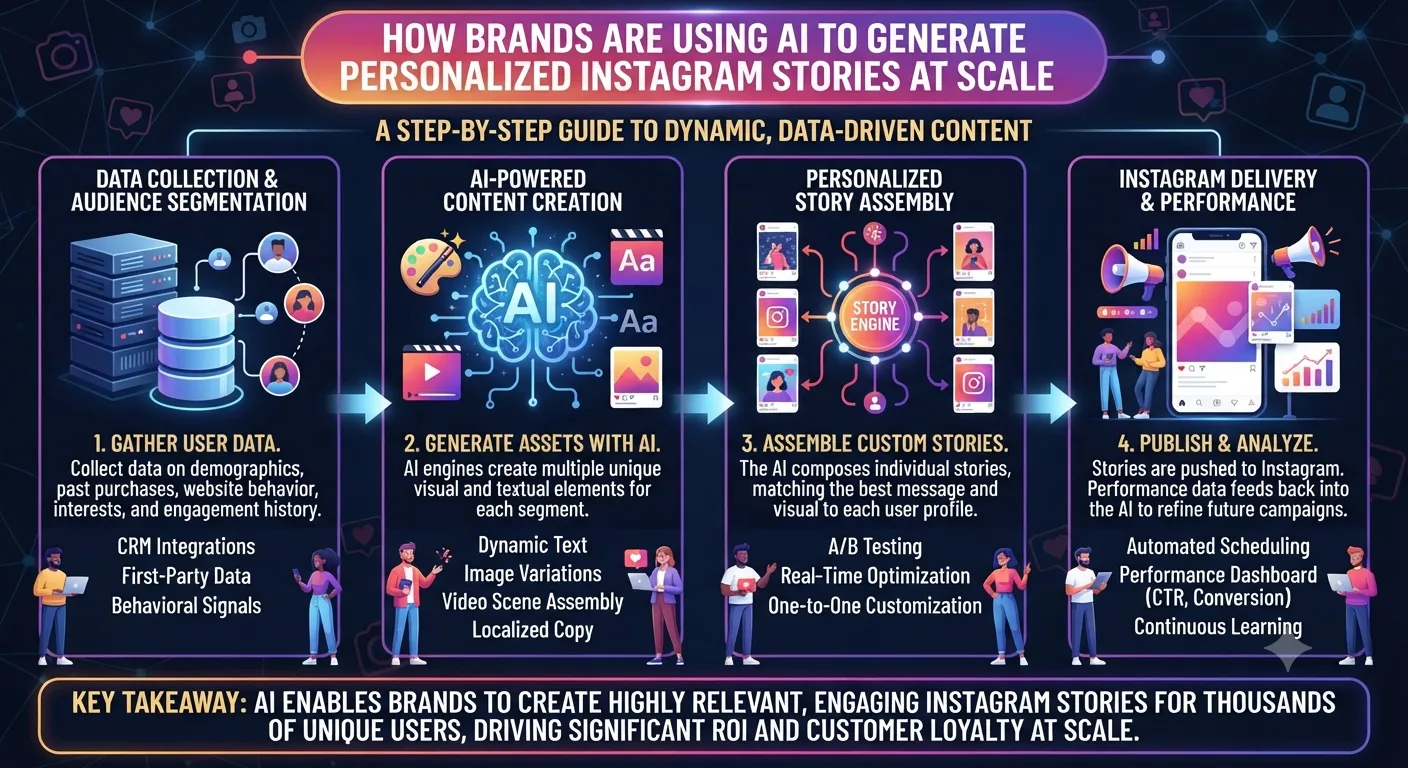
- 1Define audience segments based on available data: geography, purchase behavior, engagement level, or demographic information from your CRM or e-commerce platform.
- 2Create a master creative brief and template that defines the core message, visual style, and brand voice that all variations will share.
- 3Feed the master brief and segment-specific data into an AI content generation pipeline, often built using Claude or GPT APIs connected through Make.com or a similar automation tool, to generate tailored copy for each segment.
- 4Use AI image or template tools like Canva's API or Adobe Express to generate matching visual variations that incorporate segment-specific product images or messaging.
- 5Deploy the variations through targeted paid story placements using Meta Ads Manager's audience targeting, or through segmented Broadcast Channels for organic delivery to different follower groups.
- 6Track performance by segment and feed the results back into future campaign briefs to continuously refine which personalization dimensions actually drive the strongest results for the specific brand and audience.
Real Brand Applications in 2026
Fashion and beauty brands use AI-generated personalized stories to showcase different product categories based on past purchase behavior, generating dozens of variations from a single seasonal campaign that each emphasize the category most relevant to a specific customer segment's history.
Travel and hospitality brands use geographic personalization extensively, generating story content that reflects the traveler's likely origin market, adjusting currency references, cultural context, and even the specific destinations featured based on regional travel pattern data.
Subscription and membership businesses use behavioral segmentation to generate distinct retention-focused story content for members showing signs of disengagement versus growth-focused content for highly active members who are candidates for referral or upsell campaigns.
What This Means for Smaller Businesses
Personalization at scale is not exclusively an enterprise capability in 2026. Small businesses using accessible tools like ChatGPT or Claude combined with basic customer segmentation in a spreadsheet can implement a simplified version of this approach: generating three to five distinct story variations for their most important audience segments rather than the same generic content for everyone.
A local business might segment simply into new customers, repeat customers, and lapsed customers, generating three tailored story sequences rather than one generic sequence. This lightweight approach captures much of the relevance benefit of full-scale AI personalization without requiring enterprise marketing infrastructure.
Key Takeaways
- AI-powered personalization at scale generates distinct story variations for meaningful audience segments rather than individual one-to-one customization.
- The three main approaches brands use are geographic and cultural personalization, behavioral segment personalization, and dynamic product recommendation stories tied to customer data.
- The technical workflow combines audience segmentation data, a master creative brief, AI text and image generation, and targeted deployment through paid placements or segmented Broadcast Channels.
- Fashion, travel, and subscription businesses are among the most active adopters of AI-personalized story content in 2026, each applying the approach to their specific customer data and business model.
- Human review before deployment remains essential to maintain brand voice consistency and catch errors, even as AI accelerates the production of personalized variations.
- Small businesses can implement a simplified version of this strategy using basic customer segmentation and general-purpose AI tools without enterprise marketing infrastructure.
Frequently Asked Questions
Do I need customer data to personalize Instagram stories with AI?
Meaningful personalization requires some segmentation basis, whether that is purchase history, geography, engagement level, or even simple categories like new versus returning customers. Without any segmentation data, AI can still help generate content variations for testing purposes, but true audience personalization depends on having some data to segment against.
What tools do brands use to generate personalized Instagram stories at scale?
Common combinations include Claude or GPT APIs for text generation, Canva or Adobe Express APIs for visual variation, Make.com or Zapier for connecting data sources and automating the generation pipeline, and Meta Ads Manager or Broadcast Channels for targeted deployment to specific segments.
Is AI-generated personalized content still effective if customers realize it is automated?
Relevance matters more than the production method for most customers. A story that addresses a specific, genuine interest or need tends to be well received regardless of whether it was manually crafted or AI-assisted. The risk is not automation itself but poor execution: generic or formulaic content that fails to feel genuinely relevant despite the personalization effort.
Can small businesses realistically use AI story personalization without a large budget?
Yes. A simplified approach using free or low-cost AI tools like ChatGPT combined with basic customer segmentation in a spreadsheet allows small businesses to generate a handful of tailored story variations for their most important customer segments. This captures much of the relevance benefit without requiring the enterprise infrastructure that large brands use for extensive personalization.
How many story variations should a brand generate for a single campaign?
This depends on the number of meaningful audience segments identified. Most brands find three to seven distinct segments produces manageable complexity while capturing the majority of personalization value. Generating dozens of variations without clear differentiation between segments increases production overhead without proportional benefit, so segment definition should precede any decision about the number of variations to produce.