Every business account treats DMs differently. Some ignore them almost entirely, missing genuine purchase intent signals. Others respond only when customers initiate contact, which misses the larger opportunity of proactively engaging warm leads who have already shown interest through story interactions. The businesses converting the most followers into customers through DMs treat the inbox as an active sales channel, not a passive support line.
Here is a complete DM strategy framework built around the story engagement signals that indicate genuine purchase interest, and how to convert those signals into conversations that lead to sales.
Why Story Viewers Are Your Warmest Audience
Someone who watches your story has actively chosen to engage with your content in the moment. Unlike a feed post view, which can happen passively while scrolling, a story requires the viewer to be present and attentive for the duration of the content. Story viewers who further engage through a poll response, a sticker tap, or a reply have demonstrated an even higher level of intent.
This engagement history is exactly the kind of signal that indicates genuine interest rather than passive following. Businesses that recognize and act on these signals convert at meaningfully higher rates than those relying purely on public content to drive sales.
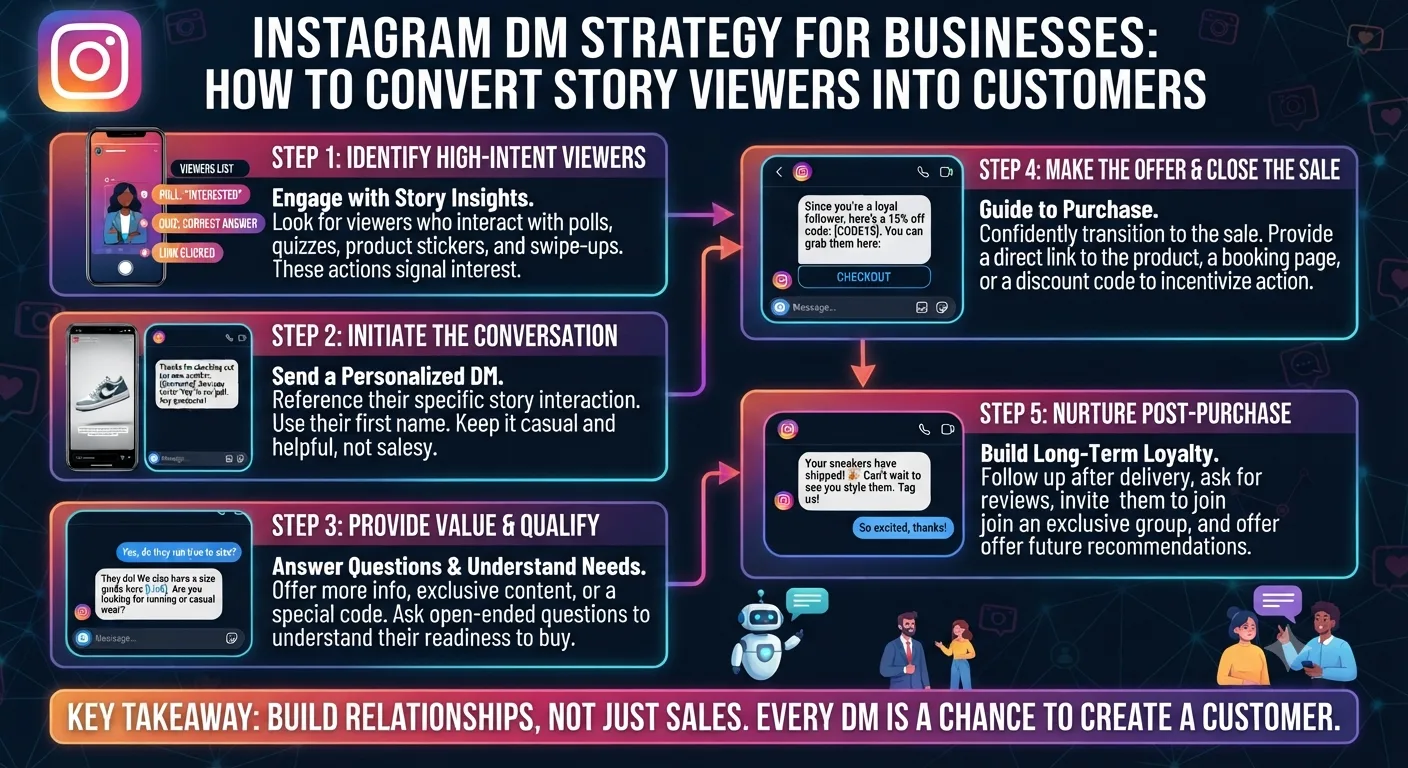
The Story-to-DM Conversion Funnel
Create Interaction-Driving Story Content
Every story that could plausibly lead to a sale should include an interactive element: a poll, a question sticker, a slider, or a swipe-up link. Passive stories give viewers no natural path into a conversation. A story asking "which color are you loving more" with a poll gives every responder a reason for you to reach out.
Identify High-Intent Responders
Review your story insights daily. Poll responses, question sticker replies, and link taps are all visible to you as the account owner. Segment these responders by the specific action taken since it informs how you follow up. Someone who tapped a product link showed higher intent than someone who answered a general poll question.
Follow Up Within 24 Hours
The relevance and warmth of the interaction decays quickly. A DM sent within a few hours of the interaction references a fresh, specific moment. A DM sent three days later feels disconnected from the original context and the response rate drops significantly. Build a daily routine of checking story engagement and following up same-day.
Personalize the Opening Message
Reference the specific interaction directly. "Saw you picked the blue one in my poll" is dramatically more effective than a generic "Hey, thanks for following!" message. Personalization signals that a human noticed their specific engagement rather than running an automated blast.
Guide Toward One Specific Low-Friction Action
Do not ask for the sale in the first message. Ask a question that continues the conversation naturally, offer additional information relevant to what they engaged with, or share a specific link related to their interaction. The goal of the first DM is to deepen the conversation, not close a transaction.
DM Opening Message Templates by Interaction Type
The specific interaction that triggered the DM should shape the opening message. Generic templates that ignore the trigger perform noticeably worse than context-specific openers.
For a poll response: reference their specific choice and ask a natural follow-up question related to it. "You picked the oversized fit in my poll, are you usually more of an oversized or fitted person?" This continues a conversation rather than pitching immediately.
For a question sticker reply: respond genuinely to what they asked or shared before introducing any commercial angle. If someone asked a product question through a sticker, answer it thoroughly first. The sales opportunity follows naturally from a genuinely helpful response.
For a link tap without purchase: acknowledge that they checked out the product and ask if they have any questions. This is a lower-pressure alternative to a discount code offer and often surfaces genuine objections you can address directly.
For a story reply or DM reaction: thank them specifically for what they reacted to or said, and ask a question that naturally extends the conversation toward their needs or interests relevant to your product or service.
What to Avoid in Business DM Strategy
Avoid sending the same templated message to everyone regardless of what triggered the interaction. Generic templates are easy to spot and feel impersonal even when the intention behind them is good.
Avoid leading with a discount code or sales pitch in the first message. This converts the interaction into a transaction before any relationship or trust has been established, which reduces long-term customer value even when it occasionally produces an immediate sale.
Avoid excessive automation that removes the human element entirely. While AI tools can help draft response templates and identify high-intent interactions, the actual conversation should feel like it comes from a real person who noticed their specific engagement, not a bot working through a script.
Scaling DM Strategy Without Losing the Personal Touch
As your account grows, manually reviewing every story interaction becomes impractical. The solution is not full automation but selective automation that preserves personalization at the moments that matter most.
Use scheduling and CRM tools to flag high-intent interactions for manual follow-up, such as direct link taps or specific product-related poll responses, while allowing lower-intent general engagement to receive a lighter-touch automated acknowledgment. This tiered approach scales your capacity without sacrificing the personalization that drives conversion on your highest-value leads.
Key Takeaways
- Story viewers who engage through polls, stickers, or link taps represent your warmest and most convertible audience segment on Instagram.
- Following up within 24 hours of a story interaction significantly outperforms delayed responses because relevance and context decay quickly.
- Personalized DM openers that reference the specific interaction convert dramatically better than generic templated messages.
- The goal of the first DM is to deepen conversation and build trust, not close an immediate sale. Leading with a discount code or pitch reduces long-term conversion quality.
- Tracking response rates by interaction type reveals which story content formats actually predict purchase intent for your specific audience.
- A tiered approach using selective automation for lower-intent interactions and manual personalized follow-up for high-intent signals scales the strategy without losing effectiveness.
Frequently Asked Questions
How quickly should a business respond to Instagram DMs?
Within a few hours for the best results, and same-day at minimum. Instagram's own research indicates that response speed significantly affects conversion likelihood in commerce conversations. For story-triggered outreach specifically, following up within 24 hours of the original interaction preserves the context and relevance that make the message feel personal rather than random.
Should businesses automate their Instagram DM responses?
Selectively. Full automation for high-intent, personalized outreach reduces conversion quality because it feels impersonal. Automation is appropriate for acknowledging lower-intent general engagement, answering frequently asked questions, and flagging high-value interactions for manual human follow-up. The most effective strategy combines automated efficiency with human personalization at the moments that matter most.
What is the best story sticker for generating DM conversations?
Question stickers generate the most direct DM conversation opportunities because they explicitly invite a written response rather than a simple tap or vote. Polls are effective for identifying interest at scale with lower individual engagement effort. The best strategy uses both, polls for broad signal and question stickers for deeper, conversation-starting engagement.
Does DM outreach after a story interaction feel intrusive to customers?
Not when done well. A DM that references their specific interaction and offers genuine value or a natural conversational continuation is generally well received because it demonstrates attentiveness. DMs that feel intrusive are typically generic, sales-forward, or disconnected from any specific interaction, which signals mass outreach rather than genuine engagement.
How do I track which story interactions lead to actual sales?
Use unique discount codes or tracked links specific to different story interaction types, and log DM conversations in a simple CRM or spreadsheet noting the trigger interaction and eventual outcome. Over time, this data reveals which interaction types and follow-up approaches convert most reliably for your specific business, allowing you to focus your effort on the highest-return activities.