Most business Instagram stories are posted without any clear connection to a sales outcome. A behind-the-scenes clip here, a product photo there, with no strategic logic connecting the content to how a follower actually moves from awareness to purchase. The businesses generating real revenue from Instagram Stories approach the format as a deliberate part of their sales funnel, not just a content obligation.
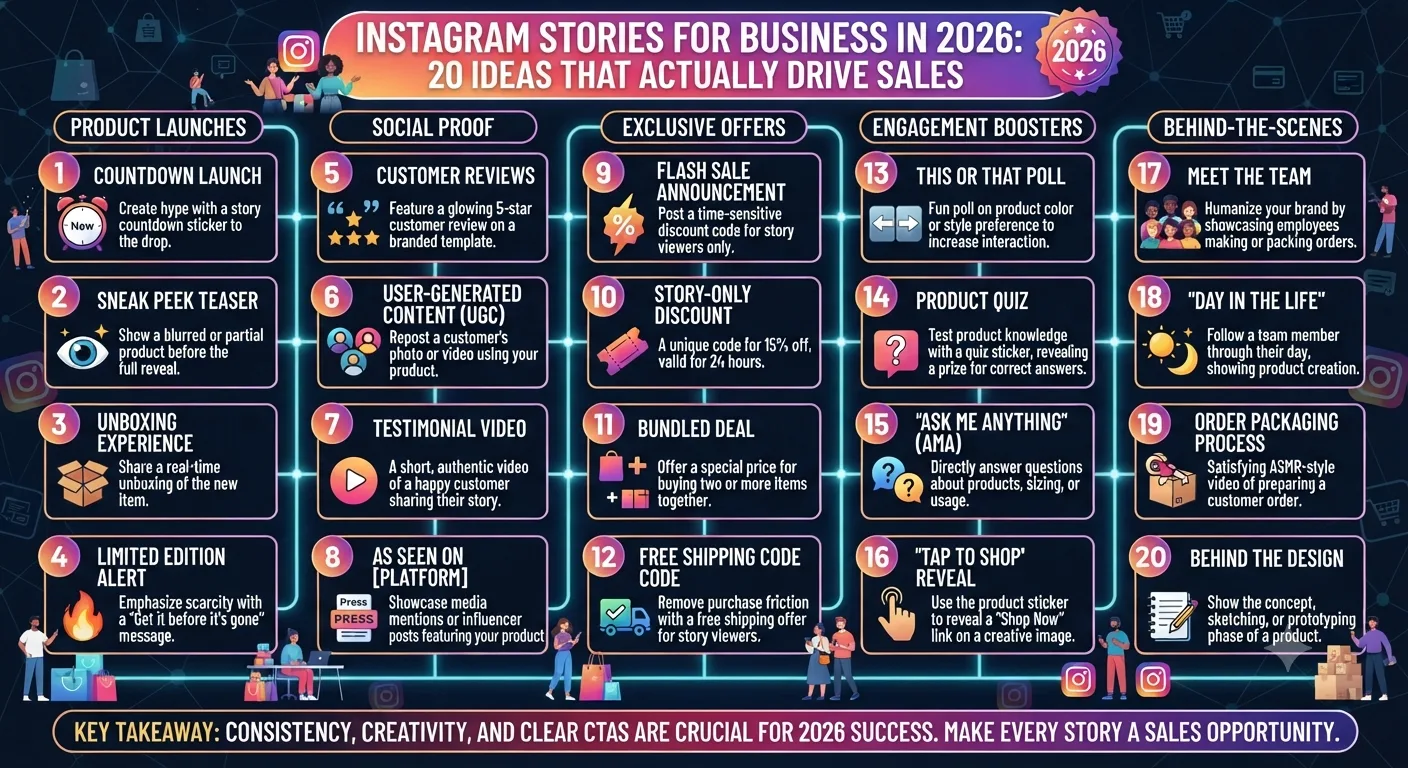
Here are twenty specific story ideas, organized by where they sit in the customer journey, with the reasoning behind why each format works.
Trust and Awareness Stage (Ideas 1 to 7)
| # | Story Idea | Why It Works |
|---|---|---|
| 1 | Founder introduction story | Puts a human face behind the brand, which increases trust for cold audience members discovering you for the first time. |
| 2 | Behind-the-scenes production process | Demonstrates craftsmanship and quality standards, justifying price and building perceived value before any sales pitch. |
| 3 | Team member spotlight | Humanizes the business beyond the founder, showing depth and stability that builds confidence in longevity. |
| 4 | Customer testimonial repost | Third-party validation is more persuasive than brand claims. Repost real customer stories with permission. |
| 5 | Common question answered | Addresses objections proactively before they become barriers to purchase, positioning the brand as helpful rather than salesy. |
| 6 | Values or mission explanation | Attracts values-aligned customers who convert at higher rates and exhibit stronger long-term loyalty. |
| 7 | Press or media feature repost | Third-party credibility signals reduce perceived risk for first-time buyers unfamiliar with the brand. |
Consideration and Intent Stage (Ideas 8 to 15)
| # | Story Idea | Why It Works |
|---|---|---|
| 8 | Product demonstration in real use | Shows the product solving an actual problem, helping viewers visualize ownership before purchasing. |
| 9 | This-or-that poll between two products | Generates engagement while surfacing genuine purchase interest signals you can follow up on directly. |
| 10 | Before and after comparison | Visually communicates transformation and outcome, which is more persuasive than a features list. |
| 11 | Unboxing or first impressions | Recreates the anticipation and reveal moment, building emotional connection to the purchase experience. |
| 12 | Comparison against a common alternative | Directly addresses the decision-making process happening in the buyer's mind, positioning your product favorably. |
| 13 | Q&A session with product questions | Live interaction resolves specific objections in real time, which static content cannot address individually. |
| 14 | Size, fit, or specification guide | Removes a common purchase barrier, particularly for physical products with variable sizing or specifications. |
| 15 | User-generated content repost with product tag | Combines social proof with direct purchase pathway, shortening the distance between inspiration and action. |
Urgency and Conversion Stage (Ideas 16 to 20)
| # | Story Idea | Why It Works |
|---|---|---|
| 16 | Limited stock countdown | Genuine scarcity signals create urgency that overcomes purchase procrastination, provided the scarcity is real. |
| 17 | Flash sale with countdown sticker | Time-boxed offers combined with Instagram's countdown sticker create a visible urgency mechanism that drives immediate action. |
| 18 | Exclusive Close Friends discount code | Rewards your most engaged audience segment while creating a sense of exclusivity that increases perceived value. |
| 19 | Last chance reminder before a sale ends | Captures buyers who intended to purchase but had not yet acted, converting latent intent into completed transactions. |
| 20 | Direct link sticker to a specific product page | Removes friction between interest and purchase by placing the exact product one tap away rather than requiring navigation. |
Building These Ideas Into a Sequence, Not Random Posts
The mistake most businesses make is treating these twenty ideas as an unordered menu, posting whichever feels convenient on a given day without regard to sequence. The businesses that convert well use these ideas as a deliberate weekly or monthly rhythm that mirrors the customer journey.
A practical weekly structure might dedicate Monday and Tuesday stories to trust and awareness content, Wednesday and Thursday to consideration content showing products in use and addressing objections, and Friday through Sunday to urgency-driven content tied to weekend shopping behavior and any active promotions. This rhythm ensures that new followers who discover your account midweek still receive the trust-building content they need before being asked to purchase.
Key Takeaways
- Effective business story content falls into three funnel stages: trust and awareness, consideration and intent, and urgency and conversion.
- Trust-building content including founder stories, behind-the-scenes production, and testimonials should precede any hard sales content for cold or new audiences.
- Product demonstration, comparison, and user-generated content are the strongest consideration-stage formats for moving interested viewers toward purchase intent.
- Genuine scarcity and time-boxed offers using Instagram's countdown sticker are the most effective urgency mechanisms for converting existing intent into completed purchases.
- Structuring content in a deliberate weekly sequence that mirrors the customer journey outperforms posting these twenty ideas randomly without funnel logic.
- Stories directly influence purchase decisions for the majority of Instagram users, making strategic story content one of the highest-leverage activities for business accounts.
Frequently Asked Questions
How many stories should a business post per day to drive sales?
Three to five stories per day balances consistent visibility with content quality. Posting fewer than this reduces your presence in followers' story trays. Posting significantly more without a clear strategic purpose for each story can lead to viewer fatigue and story skipping, which reduces the effectiveness of the content that actually matters.
Do link stickers in stories actually drive sales?
Yes, particularly when placed after trust-building or consideration-stage content rather than as a cold call to action. Link stickers placed strategically after a sequence of warming content convert significantly better than link stickers used as the primary or only content type, since they capture already-warmed purchase intent rather than trying to generate it cold.
What is the best type of story for a brand new Instagram business account?
Trust and awareness content, particularly founder introduction and behind-the-scenes production stories. New accounts have no established relationship with their audience, so building genuine trust and brand recognition should precede any sales-focused content. Jumping straight to product promotion without this foundation typically underperforms.
Should every story include a call to action?
No. Trust and awareness stage content works best without an explicit sales call to action, since the goal is relationship building rather than immediate conversion. Consideration and urgency stage content should generally include a clear next step, whether that is a poll, a link, or a direct purchase prompt, since these stages are specifically designed to move the viewer toward action.
How do I know which story ideas are working for my specific business?
Track story-driven website clicks, discount code redemptions, and DM inquiries by tagging each story type in your own tracking system. Over a month of consistent posting across all three funnel stages, you will see which specific content types in your niche generate the most measurable downstream action, allowing you to weight your content mix toward what works best for your specific audience.