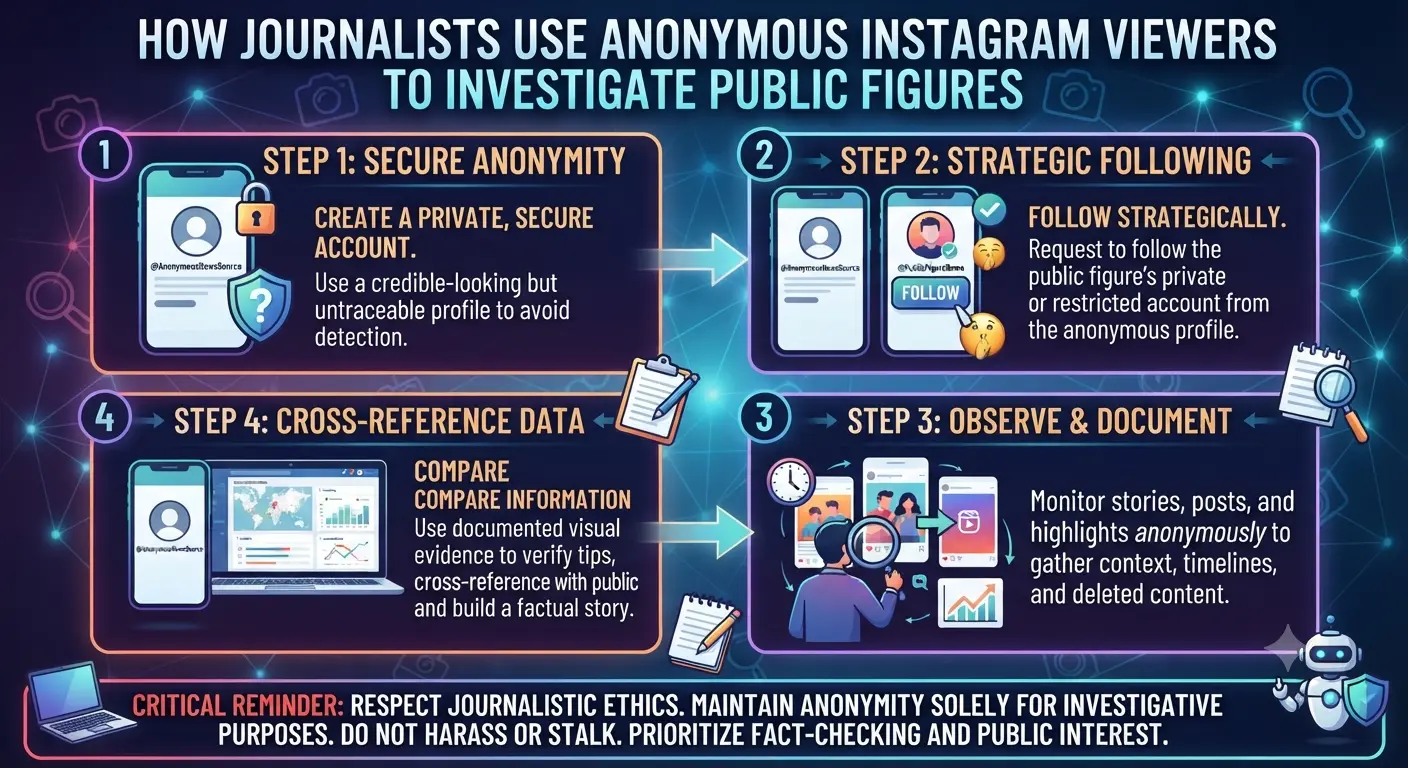
Investigative journalism has always depended on the ability to observe without being observed. A reporter showing up at a politician's event with a press badge changes how the politician behaves. A journalist following a CEO on Instagram from a recognizable media outlet account changes what that CEO posts. Anonymous observation gives journalists access to authentic, unguarded behavior that disappears the moment the subject knows they are being watched.
Instagram has become one of the most important platforms for public figures to communicate directly with their audience, often more candidly than in formal press interactions. Stories in particular reveal real-time thinking, reactions, and positions that press releases and official statements never capture. Here is how professional journalists and researchers approach Instagram monitoring ethically and effectively.
Why Anonymous Viewing Is Standard Practice in Digital Journalism
The Society of Professional Journalists' Code of Ethics supports the principle of minimizing harm while pursuing truth. For journalists monitoring public figures on social media, anonymous viewing tools serve this principle by allowing research to proceed without prematurely alerting a subject and giving them the opportunity to delete or alter content before it can be documented.
When a journalist's account appears in a public figure's story viewer list, several things can happen. The subject may notice the media affiliation and delete sensitive content. They may contact their PR team to prepare a response before the journalist has finished their research. They may become more guarded in their posting, reducing the authentic candid content that made their Instagram valuable as a reporting source in the first place.
Anonymous viewing preserves the integrity of the research process by keeping the observer invisible until the journalist is ready to seek comment, which is the standard practice in responsible reporting.
The Core Use Cases for Journalists
Monitoring Public Statements
Politicians, executives, and celebrities routinely make statements in Instagram stories that they later delete or walk back. Anonymous viewer tools allow journalists to monitor these statements in real time without alerting the subject, giving them time to document the content before the 24-hour window closes.
Evidence Preservation
Screenshots and downloads of public Instagram content serve as documentation in investigative pieces. Anonymous viewer tools allow journalists to capture this content, including timestamps and metadata, before it is deleted. Courts have accepted archived social media content as evidence in legal proceedings.
Pattern Recognition Over Time
A single story reveals a moment. A series of stories monitored over weeks or months reveals patterns, contradictions, and behavior that would not be visible in any individual post. Anonymous monitoring allows journalists to track these patterns without changing the behavior they are documenting through their own visible presence.
Cross-Referencing Public Claims
When public figures make claims in one context, journalists verify them against their Instagram activity. A politician claiming not to have attended an event whose story shows them at the location. A CEO claiming financial distress whose lifestyle content tells a different story. Cross-referencing requires access to the content without the subject knowing they are being fact-checked.
Source Development
Following a subject's Instagram activity over time helps journalists understand their interests, relationships, associates, and communication patterns before approaching them directly. This background research produces better interview questions and a more complete understanding of the subject than any amount of public records alone.
Community Research
Stories about communities, movements, or events are enriched by Instagram content from participants. Anonymous monitoring allows journalists to understand a community's internal discourse through their public posts and stories without their presence changing the community's behavior or creating a request for comment before the reporter is ready.
The Ethical Framework for Anonymous Instagram Monitoring in Journalism
Not all anonymous monitoring is ethically equivalent. Professional journalists apply a clear ethical framework that distinguishes responsible research from surveillance or harassment.
Public interest is the primary test. Monitoring a politician's public statements on Instagram serves the public interest in government accountability. Monitoring a private citizen's personal Instagram activity because a story might be written about them fails this test unless the person has become a public figure through their own actions relevant to the story.
The content accessed must be genuinely public. Anonymous viewer tools access only content that the account owner has chosen to make public. Monitoring a public figure's public Instagram is fundamentally different from attempting to access their private messages or restricted content. The former is standard journalism. The latter is illegal regardless of the tool used.
Documentation without distortion is another ethical principle. Journalists preserve content as it was posted, without manipulation. Screenshots should include timestamps and context. Archived content should be stored securely and used accurately, representing what the subject actually said rather than selectively edited excerpts.
Anonymous monitoring ends when a journalist is ready to seek comment. The purpose of anonymity is to protect the research process, not to permanently conceal the journalist's interest in the subject. Standard journalism practice requires giving subjects the opportunity to respond to specific allegations or characterizations before publication.
Practical Tools and Workflow for Journalistic Instagram Research
Beyond anonymous viewer tools, professional journalists combine several resources for comprehensive Instagram research. Web archive services like the Wayback Machine occasionally capture public Instagram profile pages, though coverage is inconsistent. Screenshot tools with automatic timestamp embedding create legally defensible records of content. Video recording software captures story content including any audio or video elements that static screenshots would miss.
The most important workflow practice is regularity. Instagram stories expire in 24 hours. A journalist monitoring a subject needs to check their anonymous viewer tool daily to ensure no relevant content disappears without documentation. Setting a daily calendar reminder for story monitoring is the simplest way to maintain consistent coverage of high-priority subjects.
Key Takeaways
- Anonymous Instagram viewer tools are standard practice in modern journalism for monitoring public figures without altering their behavior through the journalist's visible presence.
- The six core journalistic use cases are monitoring public statements, evidence preservation, pattern recognition over time, cross-referencing public claims, source development, and community research.
- The ethical framework for journalistic anonymous monitoring requires public interest justification, genuine public content, documentation without distortion, and seeking comment before publication.
- Anonymous monitoring of publicly available Instagram content is legally permissible and ethically supported by professional journalism standards.
- Daily story monitoring is necessary because Instagram stories expire in 24 hours. Missed content cannot be recovered after the window closes.
- The ethical boundary between legitimate journalism and surveillance is defined by public interest, public subject status, publicly available content, and transparent intent to publish.
Frequently Asked Questions
Is it legal for journalists to use anonymous Instagram viewers?
Yes. Accessing publicly available Instagram content through anonymous viewer tools is legal. These tools access only content the account owner has chosen to make public. No computer fraud, privacy, or data protection law is violated by viewing publicly accessible social media content, regardless of the tool used to access it.
Can Instagram content be used as evidence in journalism?
Yes. Public Instagram posts and stories can be cited and reproduced in journalism in accordance with fair use principles. Screenshots with timestamps and preserved context serve as documentation. Courts have also accepted preserved social media content as legal evidence, though the standards for admissibility vary by jurisdiction and case type.
What is the ethical difference between journalistic anonymous monitoring and stalking?
The difference lies in purpose, subject type, and intent. Journalistic monitoring targets public figures on matters of public interest and exists within a professional framework with accountability and publication standards. Stalking targets private individuals for personal, obsessive, or threatening purposes. The ethical and legal distinction is grounded in the public interest justification, not the technical method of observation.
Do journalists need to disclose that they monitored a subject's Instagram anonymously?
Disclosure standards vary by publication and journalism ethics body. Most professional journalism ethics frameworks do not require disclosure of observation methods for publicly available content. Standard practice requires disclosing the information gathered and giving subjects an opportunity to respond to specific claims, but not necessarily how the observation was conducted.
Can anonymous viewing be used to monitor private Instagram accounts for journalism?
No. Anonymous viewer tools only access publicly available content. Private accounts require follower approval, and their content is not publicly accessible through any legitimate tool. Accessing private account content through unauthorized methods would be illegal regardless of journalistic purpose. For private account research, journalists must obtain access through legitimate means including direct follow requests, source contacts, or legal processes.