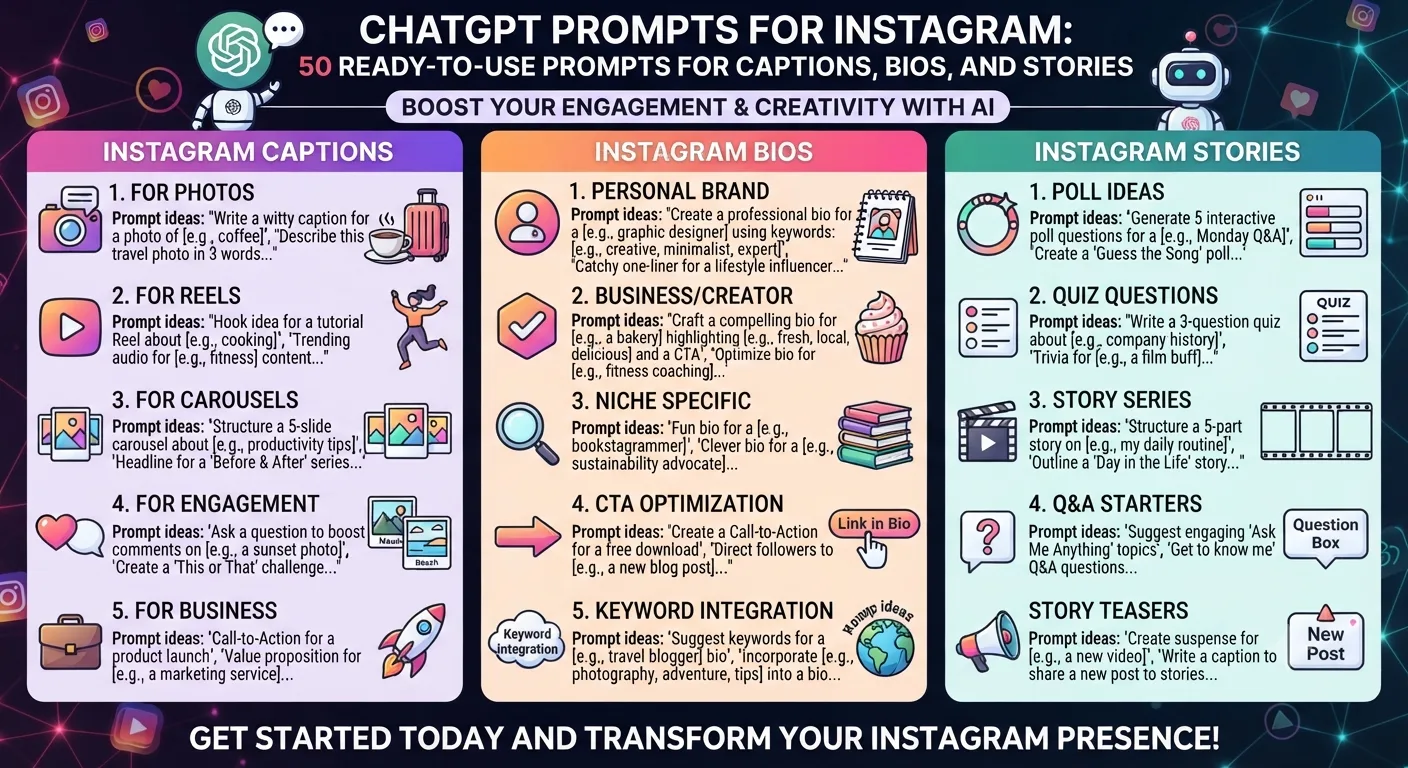
Quick Answer: The best ChatGPT prompts for Instagram are specific about tone, audience, format, and goal. Vague prompts produce generic output. Prompts that specify the niche, who the audience is, what action you want them to take, and what style the content should match produce first drafts that require minimal editing. The 50 prompts below cover every major Instagram content type.
Generic ChatGPT prompts produce generic Instagram content. The difference between a caption that sounds like every other AI-written post and one that sounds genuinely like your brand is almost entirely in how the prompt is constructed. Most creators who are disappointed with AI-generated content are using prompts that are too vague to produce anything distinctive.
Every prompt below is designed to be copied and customized with your specific niche, audience, and style in brackets. The structure of each prompt is what makes it work, not just the words.
Section 1: Caption Prompts (15 Prompts)
Caption 1 — EducationalWrite an Instagram caption for a [niche] account teaching [audience] about [topic]. Open with a surprising fact. Use three actionable tips. End with a question that invites comments. Tone: [describe tone]. Under 200 words.
Caption 2 — Story-LedWrite an Instagram caption that starts with a personal story about [experience] and connects it to [lesson or insight relevant to your niche]. Audience is [describe audience]. Conversational tone, first person. End with a save prompt.
Caption 3 — Contrarian TakeWrite an Instagram caption that challenges the common belief that [common belief in your niche]. Present a counterargument backed by [type of reasoning or evidence]. Tone: confident but not aggressive. End with a debate-inviting question.
Caption 4 — List FormatWrite an Instagram caption listing [number] things [audience] should stop doing if they want [desired outcome]. Use a numbered list format within the caption. Start with a bold hook. End with a call to share.
Caption 5 — Before and AfterWrite an Instagram caption describing the transformation from [before state] to [after state] in [niche]. Make the before relatable and the after aspirational. Tone: [describe]. Include a question asking followers where they currently are in that journey.
Caption 6 — Product FeatureWrite an Instagram caption introducing [product or service] to an audience of [describe audience]. Focus on one key benefit rather than listing features. Use sensory language. End with a CTA to [desired action]. Avoid sounding salesy.
Caption 7 — Behind the ScenesWrite an Instagram caption that gives behind-the-scenes context for [what you do or create]. Make the audience feel like insiders. Tone: warm and personal. Include one piece of information most people would not know. End with a follow prompt.
Caption 8 — Engagement Bait (Legitimate)Write an Instagram caption on the topic of [topic] that ends with a this-or-that question relevant to [niche]. The question should be specific enough to the niche that only a genuine follower would have an opinion on it. Under 100 words.
Caption 9 — Relatable FrustrationWrite an Instagram caption about a frustrating experience [audience] commonly has with [problem in your niche]. Make it highly relatable. Tone: empathetic with a touch of humor. End with the insight or solution your account provides. Include a tag-a-friend CTA.
Caption 10 — Trending Topic Tie-InWrite an Instagram caption that connects [current trend or cultural moment] to [your niche]. The connection should feel natural and insightful rather than forced. Audience: [describe]. Tone: [describe]. Under 150 words.
Caption 11 — Myth BusterWrite an Instagram caption debunking the myth that [common misconception in your niche]. State the myth clearly in the first line. Explain why it's wrong in two to three sentences. Provide the correct information. End with a save prompt.
Caption 12 — InspirationalWrite an Instagram caption for [niche] that is genuinely motivating without being clichéd. Avoid empty phrases. Ground the motivation in a specific insight about [audience's challenge]. Tone: [describe]. Under 120 words.
Caption 13 — Data-LedWrite an Instagram caption that opens with a surprising statistic about [topic relevant to your niche]. Explain what the statistic means for [audience]. Suggest one actionable response. Cite a credible source category. Under 180 words.
Caption 14 — Q and AWrite an Instagram caption in question-and-answer format. Open with a question [audience] commonly asks about [topic]. Answer it in three to four sentences. Invite followers to ask their own question in the comments. Tone: [describe].
Caption 15 — Seasonal or TimelyWrite an Instagram caption tied to [season, event, or time of year] that connects to [your niche] in a genuine way. Avoid generic seasonal messaging. Find a specific, non-obvious connection. Tone: [describe]. Under 150 words.
Section 2: Bio Prompts (10 Prompts)
Bio 1 — CreatorWrite an Instagram bio for a [niche] creator who helps [audience] achieve [outcome]. Include what they do, who they help, and one proof point or credential. Add a CTA pointing to the link in bio. Under 150 characters.
Bio 2 — BrandWrite an Instagram bio for a [type of business] brand that sells [product or service] to [audience]. The tone should be [describe]. Focus on the transformation or benefit rather than product features. Under 150 characters.
Bio 3 — Personal BrandWrite three versions of an Instagram bio for [name], a [profession or role] who creates content about [niche topics]. Each version should have a different tone: professional, conversational, and bold. All under 150 characters.
Bio 4 — Niche SpecialistWrite an Instagram bio that immediately communicates that this account is specifically for [very specific audience segment]. Use language that makes the ideal follower feel instantly recognized. Under 150 characters. Include one emoji if it fits the brand tone.
Bio 5 — Authority PositioningWrite an Instagram bio that establishes credibility for a [profession or expert type] without sounding arrogant. Include one specific achievement or credential, one thing they help their audience with, and a CTA. Under 150 characters.
Bio 6 — Community BuilderWrite an Instagram bio for an account that builds community around [topic or identity]. Focus on belonging and inclusion rather than individual credentials. Make the follower feel the account is for them. Under 150 characters.
Bio 7 — Curiosity HookWrite an Instagram bio that leads with a provocative or curiosity-generating statement about [niche] rather than a standard description. The statement should make someone want to follow immediately to learn more. Under 150 characters.
Bio 8 — Value PropositionWrite an Instagram bio that leads with the specific value a follower gets from following this account, not who the creator is. Value first, identity second. Niche is [describe]. Audience is [describe]. Under 150 characters.
Bio 9 — Humor-LedWrite a funny but on-brand Instagram bio for a [niche] account whose audience appreciates [type of humor]. The humor should be specific to the niche rather than generic. Under 150 characters. Avoid puns unless they are genuinely clever.
Bio 10 — MinimalistWrite a minimalist Instagram bio for a [niche] account. Three lines maximum. Each line should carry full weight. No filler words. No generic phrases. Under 80 characters total. Tone: [describe].
Section 3: Story Series Prompts (10 Prompts)
Story 1 — Five-Part TutorialWrite a 5-slide Instagram story series teaching [audience] how to [do something specific in your niche]. Each slide covers one step. Slide 5 ends with a poll asking which step was most useful. Keep each slide to 2 to 3 sentences.
Story 2 — Day in the LifeWrite a 6-slide Instagram story series showing a day in the life of a [creator type or role]. Each slide covers a different time of day. Make it genuine and specific, not aspirational and generic. End with a question to followers.
Story 3 — Myth vs FactWrite a 4-slide Instagram story series on [topic in your niche] using a myth vs fact format. Slide 1 introduces the series. Slides 2 and 3 each present one myth and its correction. Slide 4 asks followers to vote on a related poll.
Story 4 — Behind the ScenesWrite a 5-slide Instagram story series giving followers behind-the-scenes access to [process, event, or creation]. Make each slide a specific reveal rather than a vague overview. Include one fact most people would not know. End with a DM invite.
Story 5 — Audience Q and A SetupWrite the opening slide text for an Instagram story Q and A session on [topic]. The opening should generate high response volume by framing the question invitation in a specific and enticing way. Under 3 sentences. Include a question sticker suggestion.
Story 6 — Product RevealWrite a 4-slide Instagram story series revealing [new product, service, or offering]. Slide 1 creates anticipation. Slide 2 presents the problem it solves. Slide 3 reveals the product with one key benefit. Slide 4 drives to a link or DM action.
Story 7 — This or That Poll SeriesWrite 5 this-or-that poll questions for Instagram stories related to [niche]. Each question should be specific to the niche, genuinely debatable, and interesting enough that followers want to see results. No generic lifestyle questions.
Story 8 — Trending Topic ReactionWrite a 3-slide Instagram story series reacting to [current topic or trend in your niche]. Slide 1 introduces the topic briefly. Slide 2 gives your perspective with one specific insight. Slide 3 asks followers for their opinion. Tone: [describe].
Story 9 — Educational Quick TipWrite 5 individual one-slide Instagram story tips on [topic in your niche]. Each tip should be a complete standalone insight that delivers value in one sentence. Suitable for posting one per day over a week. Niche: [describe]. Audience: [describe].
Story 10 — Community FeatureWrite a 4-slide Instagram story series template for featuring a community member or customer. Slide 1 introduces the feature. Slide 2 shares their challenge. Slide 3 shows their result or achievement. Slide 4 invites others to submit for the next feature.
Section 4: Reels Script Prompts (10 Prompts)
Reel 1 — Hook-Led EducationalWrite a 30-second Reel script about [topic] for [audience]. Open with a hook that creates immediate curiosity in one sentence. Deliver 3 specific tips in 5 to 7 seconds each. End with a save prompt. No filler. Every second counts.
Reel 2 — POV FormatWrite a Reel script in POV format for [niche] where the viewer experiences [scenario]. Use second-person. Make the scenario highly specific and relatable to [audience]. Under 45 seconds. End with a relatable reaction or insight.
Reel 3 — Common MistakeWrite a 30-second Reel script about the most common mistake [audience] makes when [doing something in your niche]. State the mistake in the hook. Explain why it's a mistake in one sentence. Provide the correct approach. End with a follow prompt.
Reel 4 — TransformationWrite a Reel script showing the before and after of [transformation relevant to niche]. Before state in first 5 seconds. Transition at 10 seconds. After state with key change in remaining time. Under 30 seconds. Use active present tense throughout.
Reel 5 — Three-Part FrameworkWrite a 45-second Reel script introducing a three-part framework for [achieving something in your niche]. Name the framework. Dedicate 10 seconds to each of the three parts. End with a carousel or save prompt for the full breakdown.
Reel 6 — Controversial OpinionWrite a Reel script opening with a controversial but defensible opinion about [topic in niche]. State the opinion in the first 3 seconds. Spend 20 seconds defending it with one specific argument. End by inviting disagreement in comments.
Reel 7 — Rapid Fire TipsWrite a 30-second Reel script delivering [number] rapid-fire tips about [topic in niche]. Each tip should be one sentence. No explanation. Rapid delivery assumes an informed audience. End with a save prompt for people who want to revisit the list.
Reel 8 — ComparisonWrite a 45-second Reel script comparing [option A] vs [option B] in [niche]. Give each option 15 seconds. Use the final 15 seconds to declare a winner for [specific use case]. Structure for on-screen text captions as the primary information delivery.
Reel 9 — Talking Head ScriptWrite a 60-second talking head Reel script where the creator shares [personal experience or insight] about [topic in niche]. Conversational and natural. Avoid bullet-point delivery. Should feel like a genuine conversation with one specific person in the audience.
Reel 10 — Trend AdaptationWrite a Reel script that adapts the [name of trending Reel format or audio concept] to the [niche] space. Make the niche connection specific and non-obvious. The niche angle should be the creative payoff. Under 30 seconds.
Section 5: Content Idea Prompts (5 Prompts)
Ideas 1 — Monthly CalendarGenerate 30 Instagram content ideas for a [niche] account targeting [audience]. Each idea should include: post topic, recommended format (Reel, carousel, single image, or story), and one-sentence caption angle. Organize by content pillar if possible.
Ideas 2 — Competitor GapI create content in the [niche] space. My main competitors cover [topics they cover]. Generate 15 content ideas that address topics they are NOT covering but that [audience] would find valuable. Be specific and avoid generic suggestions.
Ideas 3 — Seasonal CampaignGenerate 10 Instagram content ideas for a [niche] account to use during [season, holiday, or event]. Each idea should connect the seasonal moment to the niche in a specific and non-generic way. Audience: [describe].
Ideas 4 — Evergreen BankGenerate 20 evergreen Instagram content ideas for [niche] that will remain relevant for at least 12 months. No trend-dependent topics. Focus on foundational questions, common problems, and perennial debates in the niche. Format suggestions included.
Ideas 5 — Series ConceptDevelop three recurring content series concepts for a [niche] Instagram account. Each series should have a clear format, a recognizable name, and a specific audience benefit. The series should be sustainable to produce weekly for at least 6 months.
How to get the most from these prompts: Before pasting any prompt into ChatGPT, fill in every bracketed placeholder. The more specific your placeholder text, the better the output. Add one line at the beginning of every session: "My brand voice is [describe]. My audience is [describe]. Here are 3 example captions from my account: [paste examples]." This voice brief improves every prompt that follows without requiring you to repeat it for each individual request.
Key Takeaways
- Specific prompts produce specific output. The quality of AI-generated Instagram content is almost entirely determined by the quality of the prompt, not the AI tool itself.
- Front-load every ChatGPT session with a brand voice brief including tone description, audience definition, and three example captions. This improves every subsequent prompt without repetition.
- The 50 prompts above cover captions, bios, story series, Reels scripts, and content idea generation for any niche or audience type.
- Reels script prompts should specify a time limit in seconds and delivery style because AI defaults to overly long and overly structured scripts without these constraints.
- Bio prompts require a character limit instruction because Instagram bios have a hard limit. Always include "under 150 characters" in any bio prompt.
- Generate multiple versions of any prompt output before choosing one. Asking for three variations of a caption gives you options that reveal which angle resonates best for your audience.
Frequently Asked Questions
What makes a good ChatGPT prompt for Instagram captions?
A good caption prompt specifies the niche, the audience, the tone, the format, the desired action from the reader, and a word or character limit. Prompts that include all of these elements consistently produce first drafts that require minimal editing. Prompts that omit any of these produce generic output that could apply to any account in any niche.
Should I use ChatGPT or Claude for Instagram prompts?
Both work well with the prompts above. Claude tends to produce more nuanced tonal variation and handles longer captions better. ChatGPT is faster for generating multiple variations quickly. The prompts in this guide work with either tool. Many creators use ChatGPT for ideation and variation generation and Claude for final drafting and polish.
How do I make AI captions sound less generic?
Add specificity at every possible point in the prompt: specific niche, specific audience segment, specific tone adjectives, specific content angle. Then add one or two sentences of personal context that only you could provide, a specific experience, a real data point from your own account, or a genuine opinion. This personal layer is what separates AI-assisted content from pure AI content.
How many Instagram captions can I generate with ChatGPT in one session?
There is no firm limit on the number of captions per session, though very long sessions with many prompts may encounter context limitations in the free tier. In practice, most creators find that a 90-minute focused session with clear prompts is sufficient to generate first drafts for an entire month of content across all content pillars.
Is it ethical to use AI-generated captions on Instagram?
Yes. Using AI as a writing tool is not deceptive as long as the content is accurate and genuinely represents your perspective. The ethical standard that matters is truth in content, not origin of drafting. A caption drafted by AI that you have reviewed, edited, and published as your genuine perspective meets the same ethical standard as a caption written entirely by hand. Deception would occur if AI-generated content claimed experiences or credentials that are not real, regardless of the tool used to write it.