Concerns about employer access to personal social media accounts are common and largely misunderstood. There is a wide gap between what employers are legally permitted to access, what they can practically access through indirect means, and the myths that circulate about surveillance capabilities that do not actually exist.
Here is a clear, accurate breakdown of what your employer can and cannot see on your private Instagram account, and what practical steps protect your privacy if you are concerned about the overlap between your professional and personal life.
What Employers Cannot Legally Access
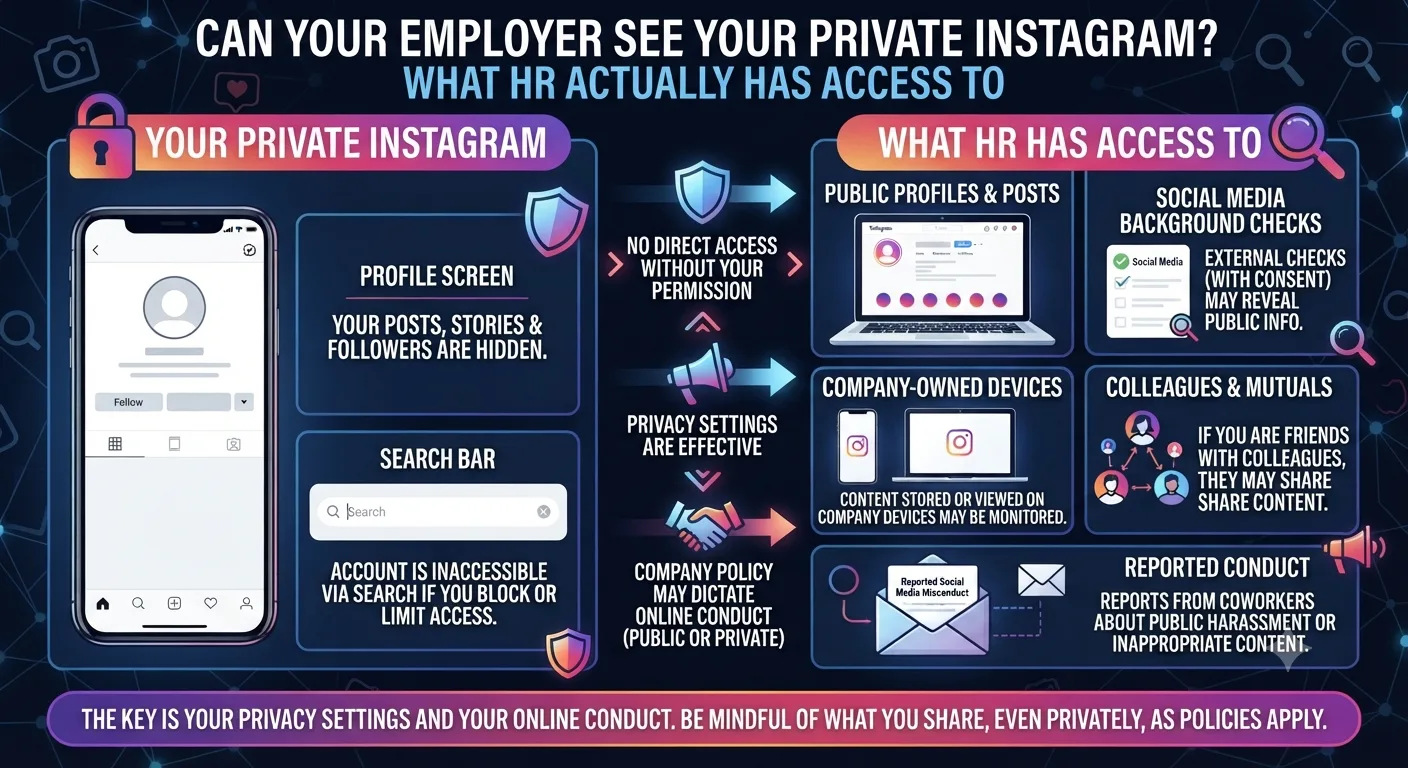
Employers have no legal mechanism to directly access your private Instagram account content without your consent. Instagram does not provide backend account access to employers, law enforcement without proper legal process, or any third party outside of your own login credentials and Instagram's own internal systems.
In the United States, several states have enacted social media privacy laws that specifically prohibit employers from requiring employees or job applicants to provide their social media passwords or grant account access as a condition of employment. As of 2026, more than half of US states have some form of this protection in place, though the specifics vary by state.
This means your employer cannot legally demand your Instagram password, cannot legally require you to add them as a follower on a private account, and cannot access your private messages, private posts, or private story content through any official channel without your explicit voluntary participation.
What Employers Can Legally Access
| Access Method | Can Employer See This? | Notes |
|---|---|---|
| Public Instagram profile and posts | Yes | Anything publicly visible is fair game for anyone including employers |
| Content shared by mutual connections | Yes, indirectly | If a coworker shares or shows your content, employers can see it through that channel |
| Content posted using a company device or account | Yes | Company-owned devices and accounts are subject to employer monitoring policies |
| Private account content (no follow relationship) | No | Not accessible without your approval as a follower |
| Direct messages | No | Never accessible to employers through any legitimate Instagram channel |
| Background check services with your consent | Limited, with consent | Some background check services review public social media as part of authorized screening |
The Mutual Connection Risk
The most common way employers actually see private Instagram content is not through any technical access method but through mutual connections. If a coworker follows your private account and sees a post, they can screenshot it, describe it, or show it to others including HR or management. This is a social risk rather than a technical or legal access issue, and it is the most realistic pathway through which private content becomes known in a workplace context.
This risk exists regardless of how strong your account's technical privacy settings are, since the vulnerability is in your network of approved followers rather than in Instagram's platform security. Being thoughtful about who you approve as a follower, particularly current coworkers, supervisors, or clients, is a more effective privacy control than any account setting.
Background Checks and Social Media Screening
Some employers, particularly for roles involving public representation, security clearances, or specific regulated industries, use third-party background check services that include a social media component. These services typically only review publicly available content and require your consent as part of the broader background check authorization process.
Reputable background check companies operating in this space generally follow Fair Credit Reporting Act guidelines in the United States, which require disclosure and consent before conducting the check and provide you the right to dispute inaccurate findings. These services cannot access private account content, only what is publicly visible at the time of the review.
Practical Steps to Protect Your Privacy From Employer Visibility
Set your account to private if you have not already, which removes your content from general public visibility including from an employer's own search or casual browsing.
Audit your follower list periodically and consider whether current coworkers, supervisors, or professional contacts who follow you align with your comfort level for what you post. This is not about excluding colleagues broadly but about being intentional given the mutual connection risk.
Review your tagged photos settings and enable manual tag approval so that photos posted by others do not automatically appear on your profile without your review, since tagged content from others may be more public-facing than content you post yourself depending on the tagger's own privacy settings.
Understand your specific state or country's social media privacy laws if you are concerned about a specific employer request. Knowing your legal protections gives you clear grounds to decline any request for account access or credentials that oversteps legal boundaries.
Key Takeaways
- Employers cannot legally access your private Instagram account content without your voluntary consent, and many jurisdictions have specific laws prohibiting employers from requiring social media password disclosure.
- Public Instagram content is fully accessible to employers just as it is to anyone else, with no special protection based on employment context.
- The most realistic privacy risk is not technical employer surveillance but mutual connections, coworkers who follow your private account and may share your content within the workplace.
- Company-owned devices and accounts are subject to employer monitoring policies that do not apply to your personal accounts accessed on personal devices.
- Background check services that include social media screening typically only review publicly available content and require your consent under regulations like the Fair Credit Reporting Act in the United States.
- Auditing your follower list and being intentional about which coworkers or professional contacts you approve is a more effective privacy control than technical account settings alone.
Frequently Asked Questions
Can my employer legally ask for my Instagram password?
In most US states and many other jurisdictions, no. Social media privacy laws in over half of US states specifically prohibit employers from requiring employees or applicants to provide social media account passwords or access as a condition of employment. Check your specific state or country's laws for the exact protections that apply to your situation.
Can HR see my private Instagram if a coworker follows me?
Not directly through any technical access, but if that coworker chooses to share, screenshot, or describe your content to HR or management, the content effectively becomes visible to them through that indirect channel. This is a social risk related to your network of approved followers rather than a technical vulnerability in Instagram's platform security.
Can I be fired for something I post on a private Instagram account?
This depends on your jurisdiction, your employment contract, and how the content became known to your employer. Many jurisdictions have some protection for legal off-duty conduct, though these protections vary significantly and often have exceptions for content that violates specific company policies, involves confidential information, or creates a documented conflict with job responsibilities. Consult local employment law resources for guidance specific to your situation.
Do background check companies see private Instagram content?
No. Legitimate background check services that include a social media component only review publicly available content, not private account posts, stories, or messages. These services require your consent as part of the broader background check authorization and are typically bound by regulations requiring disclosure and dispute rights for the information found.
Is it safe to follow coworkers on a private Instagram account?
This depends on your comfort level with your personal content potentially being seen or shared within your professional network. There is no technical risk from Instagram's side, but the social risk of workplace-related consequences from personal content increases with every professional contact who has access to your private account. Many people choose to maintain separate personal and professional social media boundaries specifically to manage this risk.