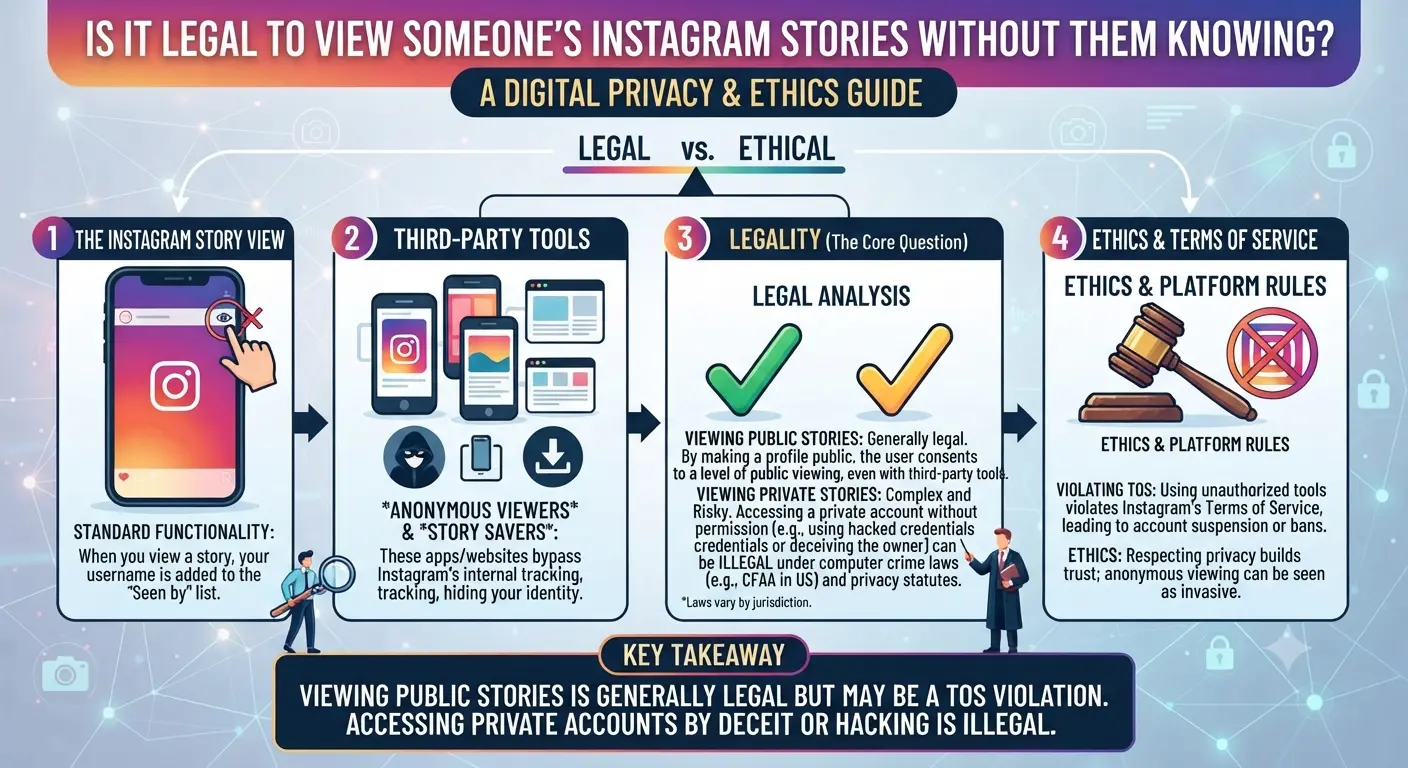
The idea of viewing an Instagram story without the person knowing raises an instinctive question about legality. If you are doing something without someone's knowledge, surely that must be crossing a line somewhere?
The answer, when examined through the lens of law rather than intuition, is clear. Anonymous viewing of public Instagram content is legal and is consistent with established principles about how publicly accessible information on the internet is treated. Here is a thorough breakdown of the legal picture in 2026.
The Core Legal Principle: Public Content Is Public
When an Instagram user sets their account to public, they are choosing to make their content visible to anyone who accesses it, logged in or not, known to them or not. This is a deliberate privacy choice made by the account owner. The legal framework that governs internet content access treats publicly available content as accessible to the public.
The United States Court of Appeals for the Ninth Circuit affirmed this principle in the hiQ Labs v. LinkedIn case, ruling that accessing publicly available data on a website does not constitute unauthorized access under the Computer Fraud and Abuse Act. While this case involved web scraping rather than casual browsing, the underlying principle extends to viewing public content: what is publicly accessible is legally accessible.
The same logic applies across most Western legal jurisdictions. The European Union's GDPR framework protects personal data but does not restrict access to content that individuals have chosen to make public. UK data protection law follows similar principles.
What the Law Actually Prohibits
Understanding the legal boundaries requires being clear about what the law does prohibit, so the permitted behavior is clearly distinguished from what is not.
The Difference Between Legal Access and Platform Terms of Service
One source of confusion is conflating legal legality with Instagram's Terms of Service compliance. These are two completely separate things and it is important to understand the distinction.
Instagram's Terms of Service are a private contract between you and Meta. Violating them can result in account suspension or being blocked from the platform. It is not a criminal matter and carries no legal penalties beyond losing access to the platform. Meta cannot have you arrested, sued by the government, or fined for using a viewer tool.
Legal law is what governments enforce. Viewing public Instagram content through a third-party tool is not a violation of any criminal or civil law in the United States, United Kingdom, European Union, Canada, or Australia under current legal frameworks.
You may technically violate Instagram's Terms of Service by using a third-party viewer tool, but that violation is entirely separate from and does not make the activity illegal.
Jurisdiction-Specific Considerations
The legal landscape is consistent across most major jurisdictions but there are nuances worth noting.
United States
The Computer Fraud and Abuse Act, the primary federal law governing unauthorized computer access, has consistently been interpreted by courts to not apply to accessing publicly available online content. The hiQ v. LinkedIn ruling is the most significant precedent. Viewing public Instagram content anonymously falls well within legal access.
European Union
GDPR concerns data processing and personal data collection, not simple viewing of public content. Accessing a public Instagram story does not constitute processing personal data under GDPR in a way that creates legal liability for the viewer. The regulation places obligations primarily on organizations that process data at scale, not on individuals viewing public content.
United Kingdom
The Computer Misuse Act 1990 criminalizes unauthorized access to computer systems but courts have consistently held that accessing publicly available content is authorized access because the content was intentionally made public. Viewing public Instagram content does not trigger the Computer Misuse Act.
When Anonymous Viewing Becomes a Legal Problem
The legal picture changes entirely when anonymous viewing is combined with behavior that crosses into harassment, stalking, or threats. If someone uses a story viewer tool to monitor an individual's location, routine, or activity with the intent to intimidate, follow, or harm them, the tool becomes an instrument of behavior that is already illegal under stalking and harassment laws in every jurisdiction. The tool itself is not the legal issue. What the viewer does with the information is.
Similarly, using content viewed anonymously to defame, blackmail, or publicly harm the account owner creates legal exposure under defamation, extortion, and harassment laws independent of how the content was accessed.
Ethical Considerations Beyond Legality
Legal and ethical are not always identical. Viewing public Instagram content anonymously is legal, but there are ethical frameworks that go beyond what the law requires and are worth considering depending on your context.
For competitive monitoring, anonymous viewing is both legal and widely considered a normal business practice. For personal relationships, the ethics depend on context and intent. For journalism and research involving public figures and organizations, anonymous content access is a standard and accepted practice.
The ethical line most people intuitively draw involves intent. Viewing public content out of curiosity or for research sits comfortably within most ethical frameworks. Viewing with intent to harm, intimidate, or invade in a way that causes real distress to the account owner shifts into ethically problematic territory even when it remains legally permitted.
Key Takeaways
- Viewing public Instagram stories anonymously is legal in the United States, European Union, United Kingdom, and most other jurisdictions with developed internet law.
- Public content is intentionally accessible to anyone. Anonymous viewer tools access only what is already publicly available, not private or protected content.
- The distinction between legal law and Instagram's Terms of Service is critical. Violating Terms of Service is a civil matter with Instagram, not a criminal one.
- Accessing private account content through unauthorized means, hacking, or bypassing authentication is illegal and is completely separate from anonymous viewing of public content.
- The legal risk in anonymous viewing is not in the viewing itself but in using the viewed content to harass, threaten, defame, or stalk the account owner.
- Legitimate use cases including competitive research, journalism, and privacy-conscious browsing of public content are clearly within legal boundaries.
Frequently Asked Questions
Is it illegal to view someone's Instagram without them knowing?
No. Viewing public Instagram content, including stories from public accounts, without the person knowing is not illegal. Publicly posted content is intentionally made accessible to anyone, and viewing it does not constitute unauthorized access under computer fraud laws in any major jurisdiction.
Can you get in legal trouble for using an Instagram story viewer tool?
Using an anonymous story viewer tool to access public content carries no legal risk. It may technically violate Instagram's Terms of Service, which is a matter between you and Meta rather than a legal one. The activity itself is not criminal or civilly actionable.
Is it legal to view a public Instagram account anonymously for competitive research?
Yes. Monitoring publicly available content from competitor accounts for business intelligence purposes is a standard and legal practice. Anonymous viewing tools simply let you do this without the competitor knowing you are monitoring them, which is a normal part of competitive analysis in most industries.
What is the legal difference between viewing public and private Instagram content?
Viewing public content is legal because the account owner has chosen to make it accessible. Accessing private content through hacking, password theft, or bypassing Instagram's authentication systems is illegal under computer fraud laws in every major jurisdiction. The account owner's privacy setting determines what is legally accessible.
Does GDPR make anonymous Instagram viewing illegal in Europe?
No. GDPR regulates the processing of personal data by organizations and individuals acting in a professional capacity. Casually viewing public Instagram content as an individual does not constitute data processing under GDPR in a way that creates legal liability. GDPR compliance obligations apply to organizations collecting and processing personal data at scale, not to individuals viewing public content.