Most creators have shifted their energy almost entirely toward Reels in the last two years, following the reach potential that video content offers. This has created an interesting gap in the data. While Reels dominate reach and discovery, carousels are quietly outperforming every other format on the two metrics that matter most for long-term audience building: saves and shares.
Here is why the carousel format remains powerful in 2026, how its algorithm works differently from Reels, and what the highest-performing carousel structures look like.
Why Carousels Drive More Saves Than Any Other Format
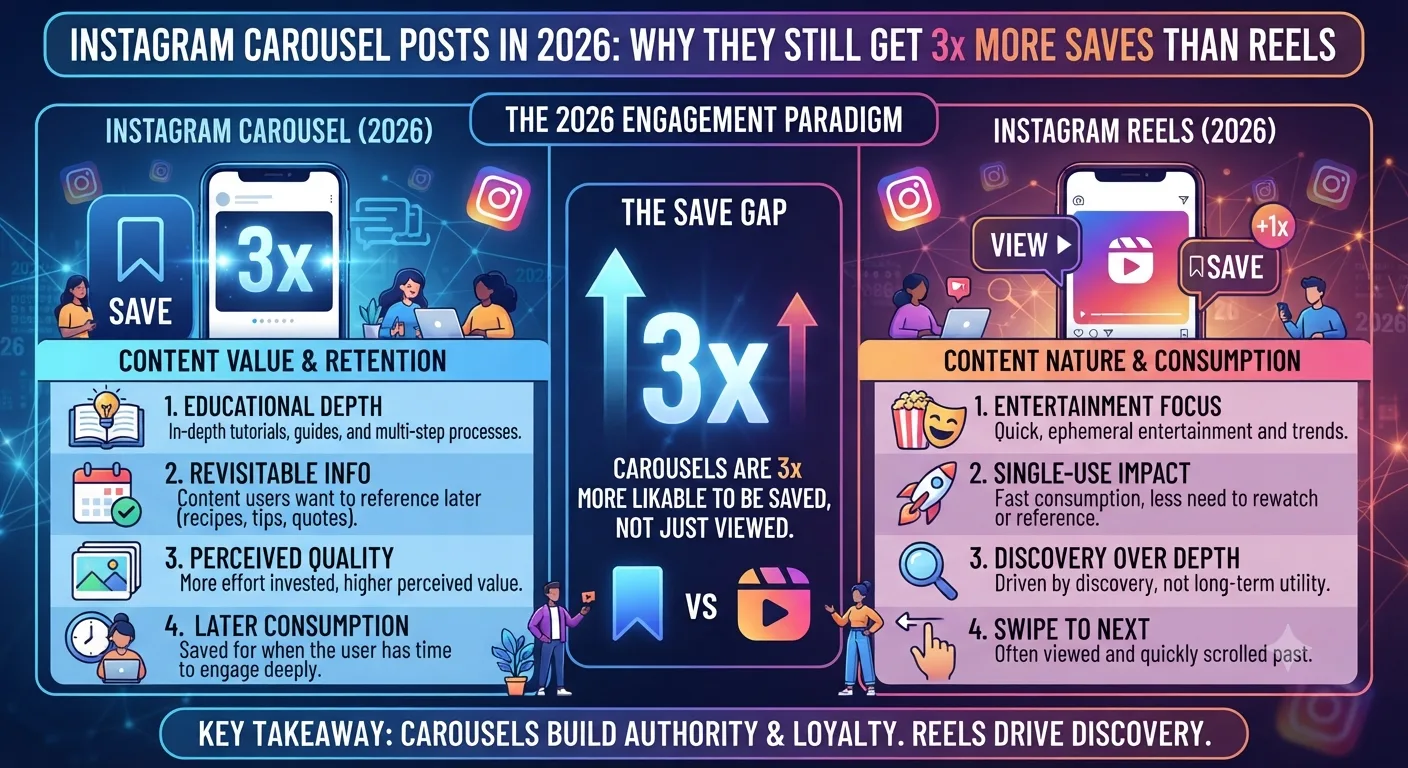
The save behavior is tied directly to the carousel format's information density. A carousel can deliver ten slides of structured, actionable content in the time it takes to scroll through one Reel. When someone encounters a carousel that teaches them something genuinely useful, presents a checklist they want to keep, or summarizes a complex topic in organized visual form, the natural response is to save it for later reference.
Reels are primarily consumed and forgotten. The entertainment or education value is delivered in real time and the viewer moves on. Carousels are collected. The save rate difference reflects this fundamental difference in how the two formats are consumed and valued.
The Carousel Second-Chance Algorithm
This is the least-discussed advantage of carousels and one of the most significant. Instagram's algorithm gives carousel posts a second distribution window that single image posts and Reels do not receive in the same way.
When a carousel is served to a portion of your followers and those followers scroll past without engaging, Instagram does not immediately count the post as low-interest. Instead, it re-serves the carousel to those same non-engagers but this time leads with the second slide rather than the first. The logic is that the first slide may not have hooked them but a different entry point might.
This effectively gives every carousel post two chances to earn engagement from the same audience pool, which doubles the opportunity window compared to a single image post that gets one shot. Creators who understand this mechanism design their second slide with this second-chance hook function in mind.
The Seven Carousel Slide Structures That Drive Saves
How Many Slides Should a Carousel Have?
Instagram supports up to ten slides in a carousel post. The optimal number depends on the content type and what it takes to deliver the value completely without padding.
Five to seven slides is the sweet spot for most educational carousels. Enough to deliver substantive value, not so many that readers drop off before reaching the call to action on the final slide. Resource lists and step-by-step guides can justify the full ten slides if each slide genuinely adds value. Carousels with only two or three slides tend to underperform because the swipe behavior and second-chance algorithm benefit are reduced.
Carousel Design Principles That Improve Performance
Visual consistency across all slides is more important than individual slide aesthetics. A viewer who needs to register a new visual style on every slide spends cognitive energy on processing the design rather than absorbing the content. Use the same fonts, color palette, and layout structure across all slides and let the content itself vary.
Text should be large enough to read without zooming on a mobile screen. The majority of Instagram is consumed on phones. If the text on your carousel slides is not immediately readable without pinching, you are losing viewers before they engage with the content.
The last slide should always include an explicit call to action. Save this for later, share with someone who needs this, and follow for more of this type of content are the three highest-performing CTAs for carousels based on engagement pattern data across the format.
Key Takeaways
- Carousel posts generate approximately three times more saves than Reels because they function as reference material that viewers return to, unlike Reels which are consumed and moved past.
- Instagram's second-chance algorithm re-serves carousel posts to non-engagers using the second slide as a new hook, giving carousels double the exposure window of single image posts.
- Treating slide two as an independent hook rather than just a content continuation significantly improves the second-chance algorithm's effectiveness for each post.
- Step-by-step guides, resource lists, and named frameworks are the three carousel formats with the most consistently high save rates across niches.
- Five to seven slides is the optimal length for most educational carousels. Ten slides is justified for genuinely dense content like resource lists and complete process guides.
- Visual consistency across slides and large readable text are the design principles with the most direct impact on carousel completion rates.
Frequently Asked Questions
Do carousel posts get less reach than Reels on Instagram in 2026?
Generally yes. Reels have a broader reach ceiling because Instagram's algorithm actively distributes them to non-followers. Carousels reach primarily your existing audience. However, carousels consistently outperform Reels on saves and shares, which are the metrics most tied to long-term audience retention and content longevity.
What is the Instagram carousel second-chance algorithm?
When followers scroll past a carousel without engaging, Instagram re-delivers the same post to those same followers using the second slide as the entry point rather than the first. This gives the post a second opportunity to earn engagement from viewers who were not hooked by the original first slide. No other content format receives this re-delivery treatment in the same way.
Should I still post Reels if carousels get more saves?
Yes. Reels and carousels serve different strategic purposes. Reels are your discovery engine for reaching new audiences through non-follower distribution. Carousels are your depth tool for delivering high value to your existing audience and generating saves and shares that compound over time. The most effective Instagram strategies in 2026 use both in combination rather than choosing one format exclusively.
How many slides should an Instagram carousel have for maximum engagement?
Five to seven slides for most educational and value-focused content. The full ten slides for resource lists, step-by-step processes, or data-heavy content that genuinely requires the space. Two or three slide carousels underperform because they reduce the swipe engagement signal and limit the second-chance algorithm benefit.
Can you make a carousel post from a Reel or video?
Yes. Screenshot or export individual frames from a video and arrange them as carousel slides. This is a common repurposing strategy that converts existing Reel content into a saveable carousel format. The visual quality of exported frames is typically sufficient for carousel use, especially for informational or educational content where the text and data matter more than cinematic image quality.