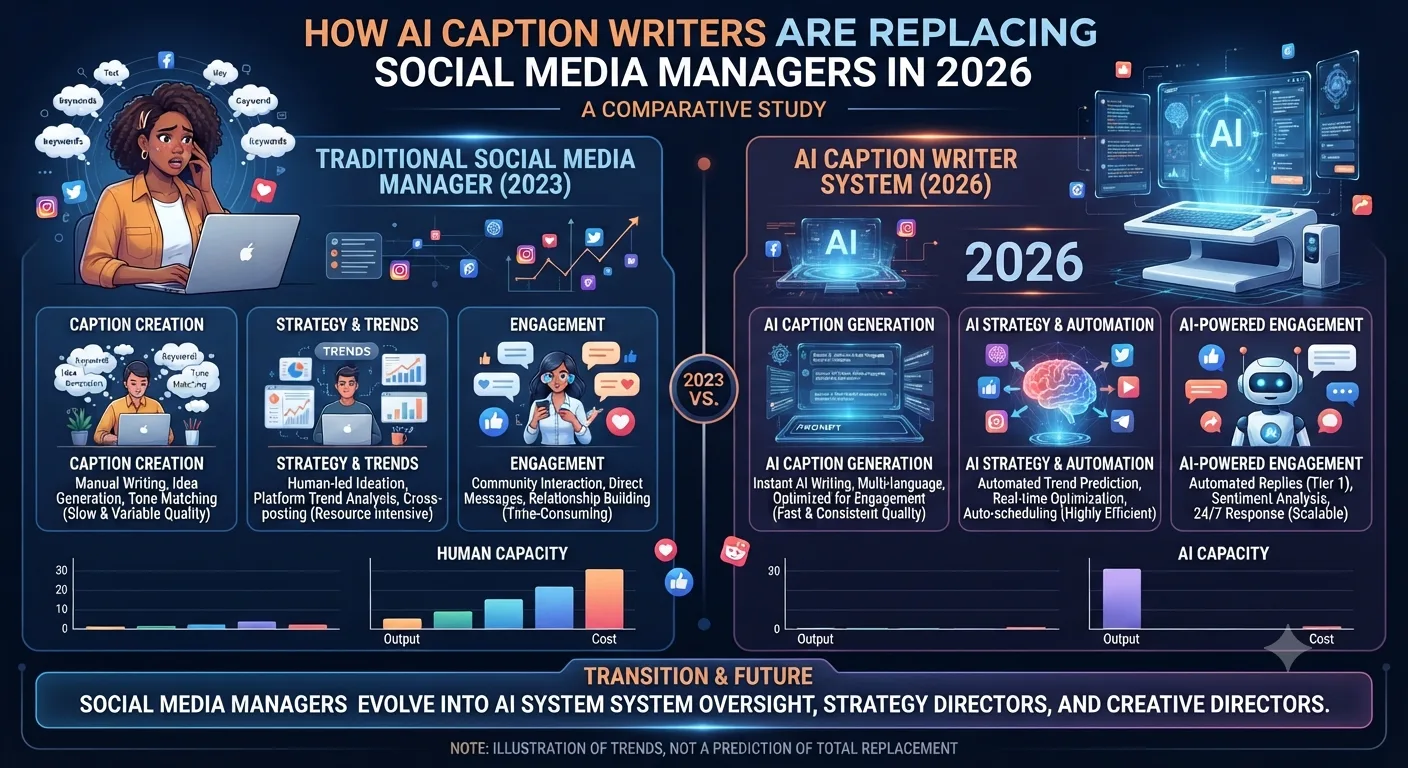
When the subject of hiring a social media manager came up two years ago, any self-respecting brand would not think twice about outsourcing Instagram caption writing. In 2026, the situation is different AI caption tools are now so advanced that small companies, solo bloggers, and even medium-sized enterprises can produce captions in-house with AI writing tools handling most of the workload.
Does this mean that caption writers and social media managers are no longer in demand? Not exactly. The job market for these professionals is transforming, and understanding what is happening on the ground is essential for everybody, from a self-employed creator to a multi-platform manager. Let us review the current state of affairs, the most popular tools, and ramifications for the industry.
Why AI Caption Writing Finally Works
Previous generations of AI writing tools produced subpar results that required editing before they could be published. This is because these early tools lacked context, meaning that they would produce captions that had nothing to do with the brand’s voice. The reason why AI caption writing finally works in 2026 is that tools that exist this year can be trained on existing content, take into account the context of the platform (Instagram, LinkedIn, etc.), and produce multiple variations of the caption.
In other words, there are now AI caption writers that can learn your brand voice, understand nuances specific to each social media network, and offer multiple options of the caption. These are the tools that make sense to use in 2026.
Tools That Perform the Best
There are several AI caption writer tools that have distinguished themselves as the clear winners in 2026. First is the ChatGPT writing tool, which offers the best flexibility and the ability to dictate terms. The main downside is that it is not directly integrated with Instagram or other platforms. Claude from Anthropic has established itself as a better alternative for longer captions and more nuanced writing, which is great for certain niches. Predis.ai and Taplio are the tools that specialize in social media captions and offer the fastest results with little or no editing needed. Finally, the AI caption generator by Later is directly integrated into the social media scheduling tool, which makes it the most convenient alternative.Limitations of AI Caption Writers
At this point in time, AI caption writers are best at coming up with new variations of the caption, writing in a specific tone, producing multiple results, and writing hooks. What these tools are not good at is understanding what is happening in the world and what the writer of the caption wants to communicate. Another limitation is the inability to replicate a natural and authentic voice on social media. For instance, a fitness trainer may want to share a personal story about achieving a goal which would have to be written either by the trainer or an AI tool that can imitate their voice. The same goes for events if a restaurant wants to post a caption about a Sunday Brunch, there is no tool that can capture the mood unless the writer has actually been to the event.
Implications for Social Media Managers
The social media managers that will most likely succeed in 2026 are the ones that utilize AI tools to increase their productivity and capacity. This means that they dedicate more time to the overall strategy and engagement while delegating caption writing to AI tools. In turn, the managers that ignore AI advancements and continue to write captions themselves will find themselves in greater competition for fewer jobs. This is because the task of writing captions is no longer time-consuming and can be delegated to an entry-level employee or an AI tool.
Conclusion: Implications for Business Owners
For the self-employed caption writers, it means that they can now do more with their time, which is limited. For business owners that write captions for their Instagram page themselves, AI tools can provide relief. It takes about an hour to learn how to use these tools effectively, and the results will be felt almost immediately. Simply select one of the tools reviewed above and give it a few examples of what you want it to write. In case of an AI caption writer, it is important to train it, provide it with examples of your own captions or captions that sound good to you. The result will be significantly better than if you used a random tool with no instructions.
Summary
AI caption writing tools are now sufficiently advanced to be useful in a wide variety of applications, from hook creation to writing full captions in a consistent tone. They can be trained to imitate specific brand voices, are useful in creating variations of a caption, and work best when given explicit instructions. These tools cannot replace writers entirely, as they require human input to function, and are not good at tasks that require a personal touch. Managers that use these tools to augment their productivity and output are likely to thrive, while those that ignore them will find themselves in greater competition. In the future, it will be necessary to invest more time and resources into strategy and less time on the caption writing itself.
FAQ
What is the best AI tool for writing captions for Instagram?
ChatGPT and Claude perform best in terms of flexibility. Other tools, such as Predis.ai and Later’s AI caption generator, are better at working with other platforms or offer a more streamlined experience.
Can AI write captions for Instagram that actually sound human?
Yes, but only if they are given sufficient context and trained on examples.
Will using AI captions to take over Instagram caption writing kill engagement?
Engagement depends on the content of the caption, which is not affected by whether it is written by a human or AI. Overall, an AI caption tool will not hurt one’s chances on Instagram.
How can I train AI to write captions in a certain style?
Provide it with examples of captions that sound good and follow the specific requirements that you have.
Is it worth it to hire a social media manager in 2026?
It depends on what you need. If you require strategic input, community management, trend spotting, or any other capacity beyond caption writing, then yes. If you only need captions, it is not necessary.