What Is a Riser Desk? Definition, Types, Benefits, Buying, Guide, If you've ever finished a long workday with a stiff neck, tight lower back, or that familiar mid-afternoon energy crash, you already know the problem that a riser desk is designed to solve.
Spending eight or more hours locked in the same seated position isn't what the human body was built for — and the modern workspace has spent decades pretending otherwise. The riser desk is one of the most practical, affordable responses to that problem, and it's rapidly becoming a standard piece of office furniture in home offices, corporate workstations, and even study rooms.
But what exactly is a riser desk? How is it different from a standing desk? What types are available, and is it the right upgrade for your setup?
This guide answers all of it — clearly, completely, and without the fluff.
What Is a Riser Desk?
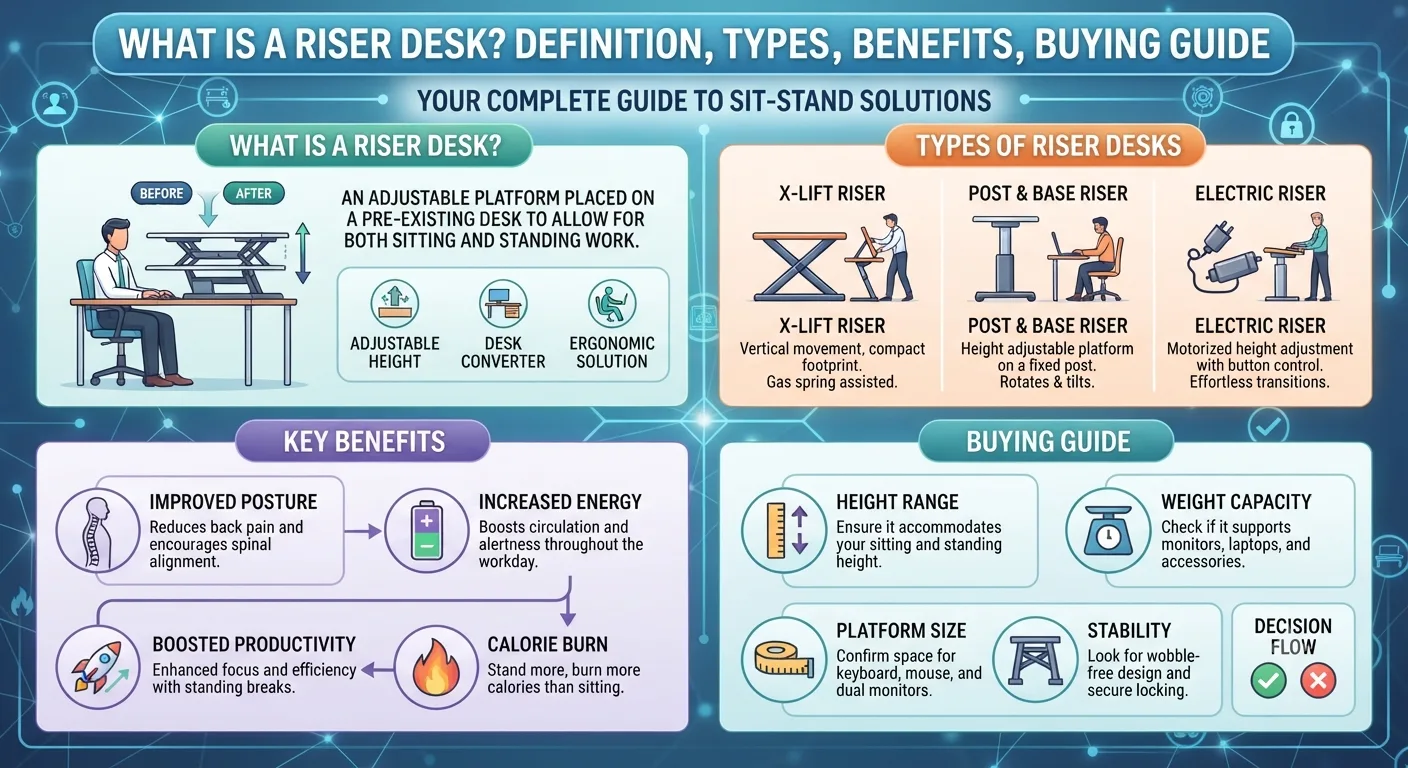
A riser desk — also called a desk riser, standing desk converter, or sit-stand converter — is a height-adjustable platform that sits directly on top of your existing desk. It raises your monitor, keyboard, and mouse to a standing-height position, allowing you to alternate between sitting and standing throughout the workday without replacing your current furniture.
Think of it as a "desk on top of a desk."
When you want to stand, you raise the platform. When you're ready to sit back down, you lower it. The whole transition typically takes just a few seconds, and your existing desk stays exactly where it is — drawers, storage, and all.
Instead of buying a completely new workstation, you simply place the riser on your current desk and adjust it whenever you want to change positions. This makes riser desks especially appealing for people who want a healthier work routine but aren't ready to invest in a full standing desk.
Riser Desk vs. Standing Desk: What's the Difference?
These terms are frequently confused, so a clear comparison matters before going further.
| Feature | Riser Desk | Standing Desk |
|---|---|---|
| What it is | Platform added on top of existing desk | Entirely new desk with adjustable legs |
| Replaces your desk? | No — sits on top | Yes — full replacement |
| Cost | $50–$300 typically | $300–$2,000+ |
| Setup time | Minutes | Assembly required |
| Workspace surface | Limited to platform area | Full desk surface moves |
| Stability | Good but limited by base desk | Generally more stable |
| Best for | Budget-conscious, renters, light use | Long-term, heavy use, multi-monitor setups |
The main difference between a riser desk and a standing desk is that a riser desk converts an existing desk, while a standing desk replaces the entire desk with a height-adjustable workstation.
The price differential of $450–$2,600+ is why some users believe it is more cost-effective to purchase a standing desk converter than a new standing desk. If you already have a solid desk, you might be better off getting this extension.
There's also a third term worth clarifying: a fixed standing desk is set permanently at standing height with no sit option, which is different from both a riser desk and a height-adjustable sit-stand desk.
How Does a Riser Desk Work?
A riser desk functions by elevating your workstation vertically. Based on the type of desk, it can utilize levers, springs, or electric motors to alter the height.
Most riser desks feature two tiers:
- Upper tier: holds your monitor or laptop at eye level
- Lower tier: provides a dedicated surface for your keyboard and mouse at elbow height
This dual-tier setup is key for maintaining proper ergonomics whether you're sitting or standing.
When you raise the platform, both surfaces rise together — keeping your screen, keyboard, and input devices in the correct ergonomic relationship with each other and with your body, regardless of whether you're sitting or standing.
Types of Riser Desks
Not all riser desks are built the same. Understanding the available types helps you choose the one that fits your setup, budget, and daily habits.
1. Single-Tier Risers
The simplest design — one flat platform that raises your monitor or laptop to a higher position. Lightweight, compact, and portable.
The limitation: no dedicated keyboard tray. You either use a separate keyboard at desk level (which creates an ergonomic mismatch) or place it on the same platform as your screen (which is rarely ideal for wrist positioning).
Best for: Laptop users who want a quick height boost, or anyone who only needs to raise a screen without full ergonomic customization.
2. Dual-Tier Risers
Dual-tier risers are the most popular design. The upper platform holds your monitor(s), while the lower tier gives your keyboard and mouse a separate, ergonomically positioned surface. This is the setup most ergonomists recommend.
The two-level design allows your screen to sit at eye level while your keyboard remains at a lower position that keeps your wrists neutral and your elbows at roughly a 90-degree angle — the gold standard for ergonomic desk posture.
Best for: Most users doing standard computer work with a monitor, keyboard, and mouse.
3. Full-Width Risers
Full-width risers span the full width of your desk and are designed for larger setups, dual monitors, full desktop workstations, or anyone who needs a lot of working surface.
These give you the most working area of any riser type but take up the most space on your base desk. If you run two monitors or need room for reference materials, paperwork, or additional peripherals, a full-width riser gives you that capacity.
Best for: Power users, dual-monitor setups, and professionals who need maximum surface area.
4. Compact Risers
Compact risers have a smaller footprint and are perfect if you're working in a shared space, a cubicle, or a smaller home office desk.
These sacrifice surface area in exchange for a smaller desk footprint, making them ideal when space is limited or when you share a workspace with others.
Best for: Small home offices, shared workspaces, cubicle environments, or anyone with a compact desk.
5. Manual Gas Spring Risers
Manual gas spring risers are the most common and use a lever-operated piston to assist the lift. They are silent, fast, and require no power outlet, making them ideal for flexible office layouts.
Gas spring mechanisms make raising and lowering the platform smooth and effortless — far easier than older screw or pin-style risers that required manual tightening at each height. Most people can adjust a gas spring riser with one hand in under three seconds.
Best for: Users who switch between sitting and standing frequently throughout the day and want the adjustment to be quick and frictionless.
6. Electric Desk Converters
For those with heavy setups or physical limitations, electric models move at the touch of a button. They often include programmable height presets, allowing you to return to your perfect standing height instantly.
Electric risers are the most convenient option — no levers or handles required, just a button press. They're also the most expensive type and require access to a power outlet.
Best for: Users who want maximum convenience, those with mobility limitations, or professionals who need to adjust height multiple times throughout the day without effort.
7. Z-Frame vs. X-Frame Designs
Two mechanical lift architectures exist in the riser desk market:
Z-frames tend to move outward toward the user as they rise, providing more legroom, while X-frames move straight up and down, which is better for compact spaces or narrow desks.
This distinction matters for how the riser interacts with your workspace geometry. If your desk is deep enough to accommodate the forward shift of a Z-frame, the added legroom is worth having. For narrower desks, X-frames are the practical choice.
The Health Benefits of Using a Riser Desk
The case for breaking up prolonged sitting is well-supported by research, and riser desks are one of the most accessible tools for doing exactly that.
Reduced Back and Neck Pain
Sitting for extended periods compresses the intervertebral discs of the spine significantly more than standing. Sitting can put up 90% more pressure on the intervertebral discs than standing, and participants have shown up to a 32% improvement in lower back pain after several weeks of using standing desks.
Regularly alternating between sitting and standing even for short periods reduces this cumulative spinal pressure meaningfully.
Less Time Spent Sedentary
A 2018 systematic review analyzed 34 studies and found that sit-stand desk interventions can reduce daily sitting time by approximately 84 to 116 minutes.
Cutting nearly two hours of daily sitting is a substantial lifestyle change, particularly for office workers who spend the majority of their waking hours at a desk.
Improved Posture
One of the quieter benefits of a riser desk is how it prompts you to think about posture. When you're standing, hunching and slouching become uncomfortable quickly — encouraging you to maintain a more upright, natural alignment that carries over into your sitting posture as well.
Experts recommend following the 20:8:2 rule: sit for 20 minutes, stand for 8 minutes, and then do 2 minutes of exercise, such as stretching or walking. A riser desk makes the sit-stand portion of this rhythm easy to achieve.
Lower Risk of Long-Term Health Issues
A review of 18 studies found that those who sit the most are at a 49% greater risk of dying early than those who sit the least. While a riser desk won't solve a sedentary lifestyle on its own, it's a meaningful step toward reducing the health risks associated with prolonged, uninterrupted sitting.
Better Energy and Focus
Many users report noticeable improvements in afternoon energy levels after incorporating standing periods into their workday. Research consistently finds a net reduction in pain symptoms, and small improvements in stress, wellbeing, vigour and pain among those who use sit-stand setups.
The mechanism is partly physical — better circulation from standing — and partly behavioral: the act of changing position provides a mental reset that can break the sluggishness that builds during long uninterrupted sitting sessions.
Calorie Burn
Standing burns 20% more calories than sitting. Over the course of a full workweek, those incremental increases in energy expenditure add up meaningfully.
How to Set Up a Riser Desk Correctly
Owning a riser desk and using it ergonomically are two different things. The health benefits only materialize if the setup is right.
Monitor Height
The top of your monitor screen should be at or just below eye level when you're standing. If the screen is too low, you'll tilt your head downward; too high, and you'll crane your neck upward. Both create the kind of neck strain that riser desks are supposed to prevent.
Keyboard and Mouse Position
Your elbows should be at approximately 90 degrees with your forearms parallel to the floor (or angled slightly downward). Wrists should be neutral — not bent up or down. Traditional office desks are between 28–30 inches high, which is only a good fit for people who are about or above 5 feet 10 inches. A properly adjusted riser corrects this for people of all heights.
Screen Distance
Your monitor should be roughly an arm's length away — approximately 20 to 28 inches from your eyes. Too close strains your eyes; too far forces you to lean forward, which undermines your posture.
Anti-Fatigue Mat
If you plan to stand for significant periods, an anti-fatigue mat is worth the modest investment. Standing on a hard floor for 30+ minutes at a stretch can cause foot and leg fatigue that discourages you from using the standing position at all. A cushioned mat eliminates most of that discomfort.
Build Up Gradually
If you're new to sit-stand working, don't immediately try to stand for half your workday. Start with 15–20 minute standing intervals and gradually extend them as your body adapts. Movement is the key factor. Short posture changes and regular breaks are more effective than standing continuously. In practice, the benefit comes from variation in position rather than standing alone.
Pros and Cons of a Riser Desk
The Pros
Cost-effective: Riser desks are dramatically cheaper than full height-adjustable standing desks. A riser desk adds sit-stand capability for $130–$250 — installing in seconds and delivering the same posture benefit as a standing desk.
No furniture replacement needed: If you have a desk you love, a riser lets you keep it while adding sit-stand functionality.
Fast setup: Most riser desks are assembled and ready to use within minutes of unboxing. There's no complex installation or tools required.
Portable: Unlike a full standing desk, a riser can be moved easily — useful for remote workers, renters, or anyone who rearranges their space regularly.
Reversible: Don't like it? Take it off. A riser desk doesn't commit you to anything. It's an addition, not a replacement.
The Cons
Reduced desk surface: Once a riser occupies part of your desktop, the remaining usable area on your base desk shrinks. A riser desk adds height, but it does not create more room. In many cases, it does the opposite. Once the riser is in place, the desktop can feel tighter and busier.
Limited to the platform: Only the items on the riser move up and down. Everything else on your base desk stays at sitting height — which means your phone, notebook, or secondary items don't automatically move with your workstation the way they would on a full sit-stand desk.
Stability limitations: At maximum height, some riser desks can wobble slightly, particularly with heavy monitor setups or on uneven surfaces. Full standing desks with motorized frames are generally more stable.
Height range constraints: Your riser's maximum height is limited by how high it can extend plus the height of your existing desk. Taller users sometimes find that the combined height still doesn't reach a comfortable standing position.
Doesn't fix a bad base desk: If your existing desk is old, wobbly, or poorly designed, a riser inherits those problems. In that case, a full replacement standing desk is the better long-term investment.
Who Should Get a Riser Desk?
A riser desk is the right choice if:
✅ You already have a desk you like and don't want to replace it
✅ You're on a budget and want to add sit-stand functionality without a large investment
✅ You rent your home or office and can't make permanent changes to the space
✅ You want to try sit-stand working before committing to a full standing desk
✅ You have limited space and a compact converter fits where a full desk might not
✅ You need a portable solution you can take with you or easily move
A full height-adjustable standing desk is probably the better choice if:
🔲 You spend 6+ hours daily at your desk and need a long-term ergonomic solution
🔲 You run a dual-monitor setup with a lot of peripheral equipment
🔲 You need the entire desk surface to move up and down, not just a section of it
🔲 Stability with a heavy setup is a priority
🔲 Your existing desk is already due for replacement
What to Look for When Buying a Riser Desk
If you've decided a riser desk is right for you, here's what to evaluate before purchasing:
Height Range
Make sure the riser's maximum height — added to your existing desk height — reaches a comfortable standing position for your body. For most adults, this means the keyboard tray ending up at roughly elbow height when standing, typically around 40–46 inches from the floor total.
Weight Capacity
Check the riser's listed weight capacity and measure your setup. A dual-monitor configuration with a large display can easily add up to 25–35 lbs. Choose a riser rated comfortably above your actual load.
Lift Mechanism
Gas spring mechanisms are smooth and require minimal effort. Older lever or pin designs can be stiff or fiddly. Electric models are the most effortless but cost more and need power. Choose based on how often you plan to switch positions — frequent switchers benefit most from smooth, quick mechanisms.
Platform Size
Make sure the riser surface is large enough to accommodate your monitor(s) and keyboard comfortably. Measure your monitors and keyboard before selecting a size.
Build Quality and Stability
At maximum height, any riser will have some degree of flex. Read reviews specifically about stability at full extension, especially if you have heavy monitors or tend to rest your hands firmly on the keyboard tray.
Frame Design
As covered above, Z-frames move outward as they rise (better legroom, needs deeper desk) and X-frames rise straight up (compact, better for narrow desks). Match the design to your workspace geometry.
Riser Desk vs. Height-Adjustable Desk: Which Is Right for You?
Here's the honest answer: it depends on where you are in your sit-stand journey.
If you've never worked at standing height before and aren't sure you'll stick with it, a riser desk is an excellent, low-risk entry point. Spend a few months using it. If you find yourself using the standing position daily and wanting more — more surface area, more stability, cleaner aesthetics — then you'll have earned the knowledge to confidently invest in a full sit-stand desk.
Riser desk usually costs less because it borrows your existing desk. A standing desk costs more when it has to replace the whole workstation. But the real question is whether your current desk deserves to stay. If it does, a riser is the smart starting point. If it's already showing its age, a full replacement makes more sense from the beginning.
Neither option is wrong. They're just right for different situations.
Frequently Asked Questions
What is the difference between a riser desk and a standing desk? A riser desk is a platform that sits on top of your existing desk and raises just the portion your keyboard, mouse, and monitor sit on. A standing desk replaces your entire desk with one whose surface moves up and down. A riser is cheaper and faster to set up; a standing desk offers more stability and a full-surface adjustment.
Is a riser desk worth it? For most people who work at a desk for several hours a day, yes. A riser desk reduces prolonged sitting time, can improve posture, and reduces back and neck discomfort — all at a fraction of the cost of a full standing desk. If you already have a desk you like, it's one of the most cost-effective ergonomic upgrades available.
How high should a riser desk be set? When standing, your keyboard tray should be at elbow height with your arms at roughly 90 degrees, and the top of your monitor screen should be at or just below eye level. For most adults, this means the keyboard surface ending up around 40–44 inches from the floor total (base desk height plus riser height).
Can any desk support a riser desk? Most solid desks can support a riser. The key considerations are surface stability (a wobbly desk makes a wobbly riser), weight capacity, and available desk depth. A desk at least 24 inches deep with a solid surface and no major structural weaknesses will work for most riser models.
How long should I stand while using a riser desk? The 20:8:2 rule is a practical starting point — sit for 20 minutes, stand for 8, and move for 2. Newcomers should start with shorter standing intervals (10–15 minutes) and build up gradually. Standing continuously for long periods is not the goal; alternating positions regularly is.
Do I need an anti-fatigue mat with a riser desk? Not strictly required, but highly recommended. Standing on a hard floor for extended periods causes foot and leg fatigue that discourages use. An anti-fatigue mat makes longer standing intervals noticeably more comfortable and keeps you using the riser consistently.
Are electric riser desks better than manual ones? Electric models offer more convenience — push-button adjustment with programmable height presets. Manual gas spring models are more affordable, require no power, and adjust quickly enough for most users. Electric makes the most difference if you switch positions very frequently throughout the day or have physical limitations that make manual adjustment difficult.
Final Thoughts
A riser desk is one of the simplest, most effective upgrades you can make to a home office or workspace. It doesn't require replacing your furniture, spending thousands of dollars, or committing to a dramatic lifestyle change. It just gives you the option to stand — and that option, used consistently, can make a meaningful difference in how your body feels at the end of a long workday.
Whether you choose a compact dual-tier model, a full-width gas spring riser, or an electric converter with height memory, the key is actually using it. Alternate between sitting and standing regularly, set it up correctly so your posture benefits rather than suffers, and build the habit gradually.
The best workspace is one that moves with you not one that holds you in the same position for eight hours straight. A riser desk is a straightforward, affordable way to start making that shift.
Read More :