Quick Answer: Yes. If you never tag a location on Instagram or authorize GPS tracking via the application, Instagram still knows where you are approximately located based on your IP address, and can still use that approximate knowledge in the background of Instagram use without you authorizing any specific location tagging.
Numerous users would assume that if they simply avoid location tags on their own posts and deny access to GPS tracking in the Instagram application, Instagram will be unaware of their location. This is a fair but demonstrably untrue assumption, as there are multiple levels of location tracking that occur regardless of specific settings within the application.
Below is an explanation of how Instagram tracking works, and what settings actually affect this tracking.
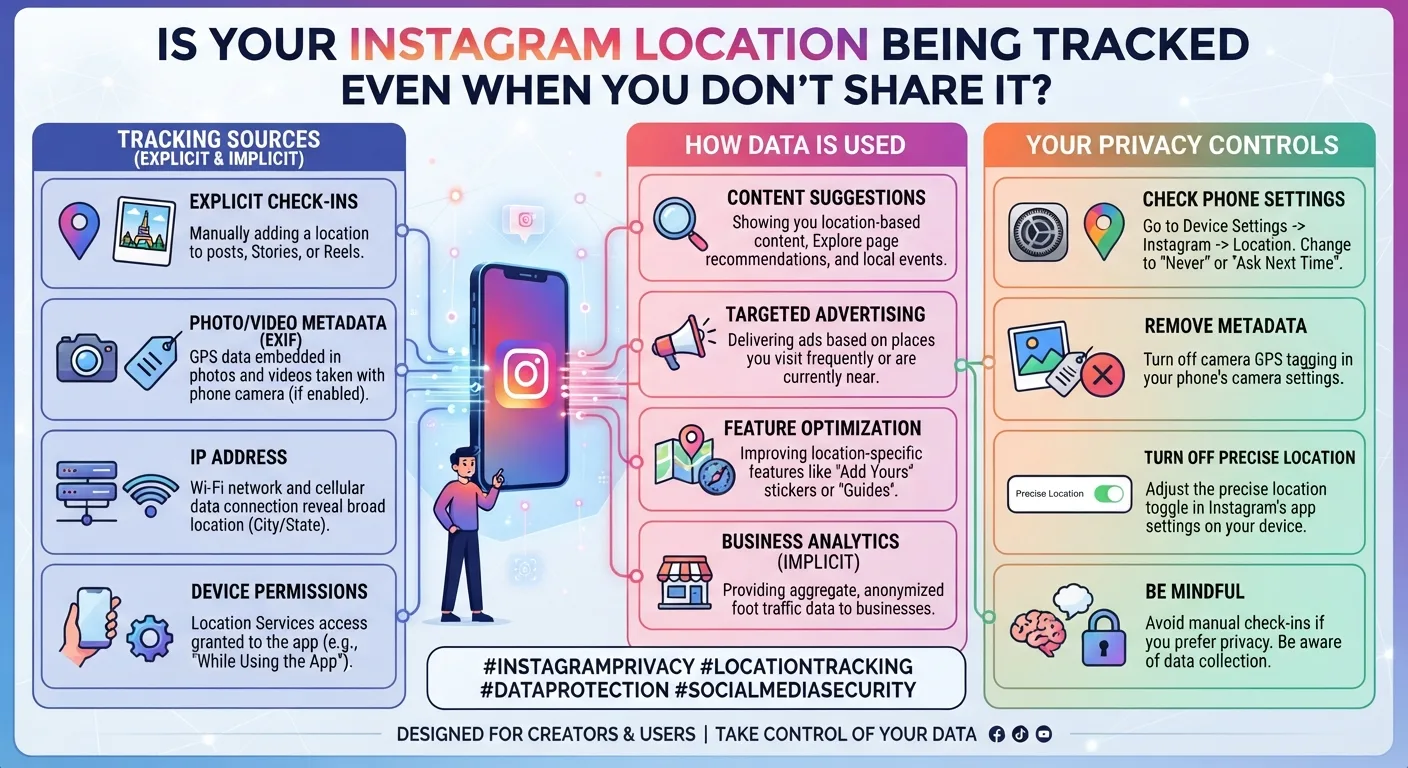
The Three Ways Instagram Knows Where You Are
Level 1: GPS Tracking – This is what most people think of when discussing location tracking.
This refers to the ability of Instagram to know your precise location down to the building or street address, and requires a specific permission to be granted via your device settings for Instagram to function. This permission is fairly broad, granting access to any application that asks for it, and will allow Instagram to know your precise location at any time. This is what allows Instagram to suggest locations to tag on posts, and suggests locations in other ways.
Level 2: Location Approximation Via IP – This form of location tracking is somewhat of a middle ground.
It does not require specific permission to be granted within your phone settings, but it also does not provide precise location information the way GPS does. Instead, it uses your IP address to approximate your location based on your general area. This is fairly accurate, generally speaking, as most people are fairly close to the center of their area of coverage, but it is not precise.
Level 3: Inferred Location – This form of location tracking refers to general location data that can be inferred based on the user’s actions within the program.
This can include things like the language and region settings on your phone, time zone information, account information, and the general location information of accounts you follow or interact with heavily. This is how Instagram can know to suggest Turkish restaurants to you if you regularly post about or interact with Turkish accounts, or if you frequently post pictures of a particular landmark or location.
In summary, a person who has never tagged a location on a post, denied GPS access completely, and takes other measures to avoid location tracking can still potentially receive location-based advertisements or recommendations, because even if they are not directly giving Instagram location information, Instagram can still infer some general information about the user’s location.
This does not mean that any specific location information is available, but general location information can still be useful to advertisers, and is therefore collected by default.
What Really Limits Location Information
A Virtual Private Network, or VPN, will conceal your IP address behind that of the server you connect to, limiting the ability of any program or service to approximate your location based on your IP address.
Denying GPS access at the phone level rather than the application level will prevent Instagram from accessing precise GPS information, as this permission is granted or denied by the phone rather than the application itself.
Being generally mindful of location tags and cues within your own content and the accounts you follow will limit inferred location information, although it is a fairly indirect method of limiting location tracking.
Method What It Limits Effectiveness
Denying GPS permission at device level GPS precision Highly effective
Using a VPN Location approximation via IP Moderately to highly effective
Avoiding location tags and check-ins Direct location association with posts Effective
Avoiding location cues in content Inferred location information Partially effective, difficult to control
Adjusting device time zone or language Contextual location inference Minor effect, not a primary control method
Why Instagram Tracks Your Location So Heavily
Location approximation has a variety of general purposes within the Instagram ecosystem. It enables general localization features such as language suggestions and area-specific content discovery, enables security features such as detecting potentially fraudulent logins from unfamiliar locations, and enables advertising, among other potential functions. Advertising purposes are the primary reason most people think of when the topic of Instagram knowing user locations is brought up, but it is by no means the sole reason.
The only way to completely ensure that Instagram will not know your location is to refrain from using the application altogether.
However, for people who want to use the service but do not want to give up too much personal information, there is another alternative: using a faceless account and an anonymous viewer. These do not provide any real anonymity if you are using them to view regular Instagram accounts, as those accounts will still have personal information attached to them, but they can be used to browse content without personally linking any location data to your own account. This is not useful for people who want to maintain their own Instagram accounts, but it is the most anonymous way of using the service for people who do not necessarily want to maintain an account.
How to Avoid Location Tracking Completely While Using Instagram
The above-listed information can be summarized in a few short points.
Instagram knows where you are approximately located based on your IP address, and can use this information to suggest or recommend location-based suggestions or advertisements. This cannot be turned off from within the Instagram application, but can be limited or turned off entirely through device settings or other methods. A Virtual Private Network, or VPN, will conceal your IP address and prevent Instagram from approximating your location based on this information, and denying GPS access at the device rather than the application level prevents Instagram from accessing precise GPS information about your location, although this permission is generally only used for suggestions or location tags on posts. This location information is useful to Instagram for a variety of reasons beyond just advertising, including security and localization purposes.
While there are not any specific settings that will prevent Instagram from knowing your approximate location while still allowing you to use the application normally, there are specific methods that will limit the ability of Instagram to know your precise location or utilize this information for purposes beyond general location-based recommendations.
Frequently Asked Questions
Does Instagram know my location if I never enable GPS access?
Yes, but only approximately. Even if the GPS access permission is not granted, Instagram will still be aware of where you are located, approximately, based on your IP address. This is a normal feature of any online service, and cannot be disabled from within the Instagram application.
Does a VPN actually stop Instagram from knowing my location?
VPNs are fairly effective at stopping Instagram from knowing your precise location, as they will disguise your IP address and make it much more difficult to approximate your location based on this information. They do not stop GPS tracking, however, if that permission is granted, and they do not completely stop inferred location information.
Why do I see location-relevant ads on Instagram if I never shared my location?
This is generally due to location approximation via IP address. This form of location tracking does not require any specific permission to be granted within the Instagram application itself, and is generally fairly accurate.
Is it possible to use Instagram with zero location data collection?
It is not truly possible to be completely anonymous on Instagram, as some degree of location tracking is generally required to use the service at all. A Virtual Private Network will disguise your IP address, denying Instagram the ability to approximate your location, and denying location permissions at the device level rather than the application level will prevent Instagram from accessing precise location data about where you are. Neither of these options are truly comprehensive, however, as there are still other methods that Instagram can use to approximate your location, even if it is not completely accurate.
Does turning off location services on my phone completely stop Instagram from knowing where I am?
It will prevent Instagram from accessing precise GPS data about your location, which is useful for things like location tagging on posts. It will not, however, prevent Instagram from accessing approximate location information via your IP address, which is useful for things like suggesting locations to tag or suggesting similar accounts. Turning off GPS tracking at the device level and using a Virtual Private Network are both fairly useful methods of limiting the extent to which Instagram knows your location, and are both fairly effective.