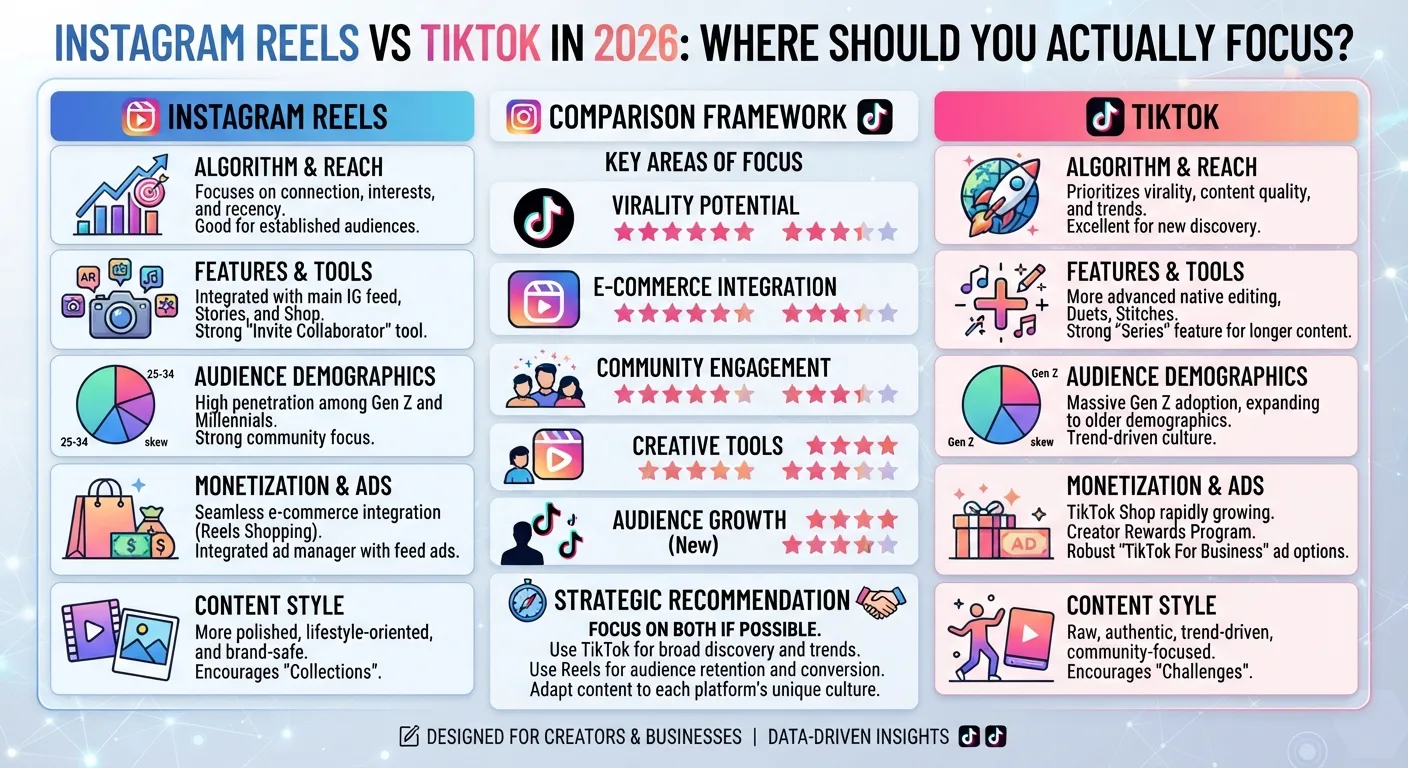
Instagram launched the Collab feature in late 2021 and it remains one of the most underused growth tools on the platform four years later. Most creators are aware it exists but very few have built a systematic strategy around it. Those who have tell a consistent story: Collab posts deliver reach and follower growth that is disproportionately large relative to the effort they require.
Here is everything you need to know to use Instagram Collabs strategically in 2026, including how they work mechanically, why they perform so well algorithmically, and which types of partnerships produce the best results.
How Instagram Collab Posts Work
When you create a Collab post, you invite a second account to co-author the content. Once they accept, the post appears on both profiles simultaneously as if both accounts created it independently. But instead of two separate posts with separate engagement, there is one single post with one unified engagement pool that both accounts share.
This means a like from one of your followers and a like from one of your collaborator's followers both count toward the same post. The comment section is shared. The view count is shared. The saves are shared. Both accounts see the full combined engagement in their own analytics.
How to Create a Collab Post on Instagram
- 1Create your post or Reel as you normally would and proceed to the final sharing screen.
- 2Tap "Tag People" on the sharing screen.
- 3Select "Invite Collaborator" rather than a standard tag.
- 4Search for and select the account you want to collaborate with.
- 5Post the content. The collaborating account receives a notification and a request to accept the collaboration.
- 6Once they accept, the post appears on both profiles with shared engagement metrics immediately.
Why Collab Posts Perform Better Than Standard Posts
The algorithmic reason Collab posts outperform standard posts is straightforward. Instagram's algorithm treats a Collab post as content with two distinct audience pools being tested simultaneously. The post reaches followers of both accounts in the initial distribution window, giving it a much larger and more diverse initial engagement sample than a solo post from either account alone.
A larger initial engagement sample generates more total engagement signals in the first hour. More signals in the first hour triggers wider distribution in Instagram's progressive amplification system. This is why Collab posts consistently outperform solo posts even when both accounts are similar in size and content quality.
The Best Partnership Types for Collab Posts
Complementary Niche Partners
The highest-performing Collab arrangements are between accounts in complementary niches whose audiences overlap significantly but are not identical. A fitness creator collaborating with a nutrition creator. A travel photographer collaborating with a travel gear brand. A parenting creator collaborating with a children's book author. Each partner brings an audience that is genuinely interested in the other's content, which maximizes new follower conversion from the collaboration.
Same-Size Account Collabs
Collaborating with accounts of roughly similar size to your own produces the most balanced results. Both accounts gain comparably from the shared reach. Collaborating with a much larger account is attractive but requires offering genuine value to the larger partner since the reach exchange is asymmetrical. Collaborating with much smaller accounts is generous but produces limited benefit for the larger partner.
Brand and Creator Partnerships
Brands use Collab posts to extend paid partnership content onto the brand's own profile with shared engagement. This is increasingly standard in influencer contracts in 2026. A brand pays a creator to produce content, the creator posts it as a Collab with the brand's account, and the post appears on both profiles with the brand getting direct access to the creator's audience reach and engagement.
Event and Launch Collabs
Time-sensitive content like product launches, event announcements, and limited-time campaigns perform particularly well as Collabs because the urgency drives faster engagement from both audiences simultaneously, which boosts the initial signal strength that triggers the algorithm's progressive distribution.
Common Mistakes With Instagram Collabs
Choosing collaborators purely on follower count rather than audience quality is the most common mistake. An account with 200,000 followers in an unrelated niche adds less value to a Collab than an account with 20,000 highly engaged followers in a closely related niche. Audience relevance and engagement rate matter more than raw follower numbers.
Not having a clear content brief before the Collab is another frequent issue. Both accounts should agree in advance on the topic, format, and tone of the content, and on what outcome each account is hoping for from the collaboration. Misaligned expectations lead to content that feels inconsistent and performs below both accounts' individual standards.
Key Takeaways
- Instagram Collab posts allow two accounts to co-author one post that appears on both profiles with completely shared engagement, likes, comments, saves, and reach.
- Collab posts consistently deliver 40 to 100 percent higher reach than solo posts because they test against two audience pools simultaneously in the initial distribution window.
- The best partnerships are between complementary niche accounts of similar size whose audiences overlap but are not identical.
- Brands increasingly use Collab posts in influencer contracts to gain direct profile placement and shared engagement from creator content.
- Audience engagement rate and niche relevance matter more than follower count when selecting collaboration partners.
- One well-executed Collab post per week or fortnight is enough to produce a measurable impact on reach and follower growth over a 30-day period.
Frequently Asked Questions
Can you do a Collab post with more than two accounts on Instagram?
As of July 2026, Instagram Collab posts are limited to two co-authors. You can tag additional accounts as regular tags in the post, but only two accounts can be official co-authors sharing the engagement pool and profile placement.
What happens to the Collab post if one account deletes it?
If the original creator who posted the Collab deletes it, the post is removed from both profiles. If the collaborating account removes the Collab from their profile through the "Remove Collaboration" option, it remains on the original creator's profile but is no longer shared with the collaborator's audience.
Do both accounts need to be public for a Collab post to work?
Yes for maximum reach benefit. If either account is private, the Collab post's visibility is limited to the followers of the private account for that account's placement. For a Collab to deliver its full reach potential to both audiences, both accounts should be public at the time of posting.
How do you approach another creator about doing an Instagram Collab?
DM them with a specific content idea rather than a general collaboration request. Explain the mutual benefit clearly, what their audience gets from the content and what yours gets, and propose a concrete topic or format. Creators respond to specific, well-thought-out pitches significantly more often than to vague collaboration offers.
Can Collab posts be used for Reels as well as feed posts?
Yes. The Collab feature works for both feed posts and Reels. Collab Reels typically outperform Collab feed posts on raw reach because the Reels algorithm is designed for broader non-follower distribution. For maximum reach impact, Collab Reels are the format to prioritize.