Two years ago, running a successful Instagram account required either significant time investment, specialized creative skills, or both. Video editing, graphic design, caption writing, community management, and analytics review each demanded distinct competencies. The creator who could do all of them well was rare, and the ones who could afford to hire people to help had a structural advantage.
AI has disrupted that equation. In 2026, a solo creator with strong strategic thinking and audience understanding can produce content that rivals what took a team to create in 2022. Here is a data-driven look at what has actually changed and what it means for anyone building a presence on Instagram.
The Numbers: How AI Has Changed Creator Economics
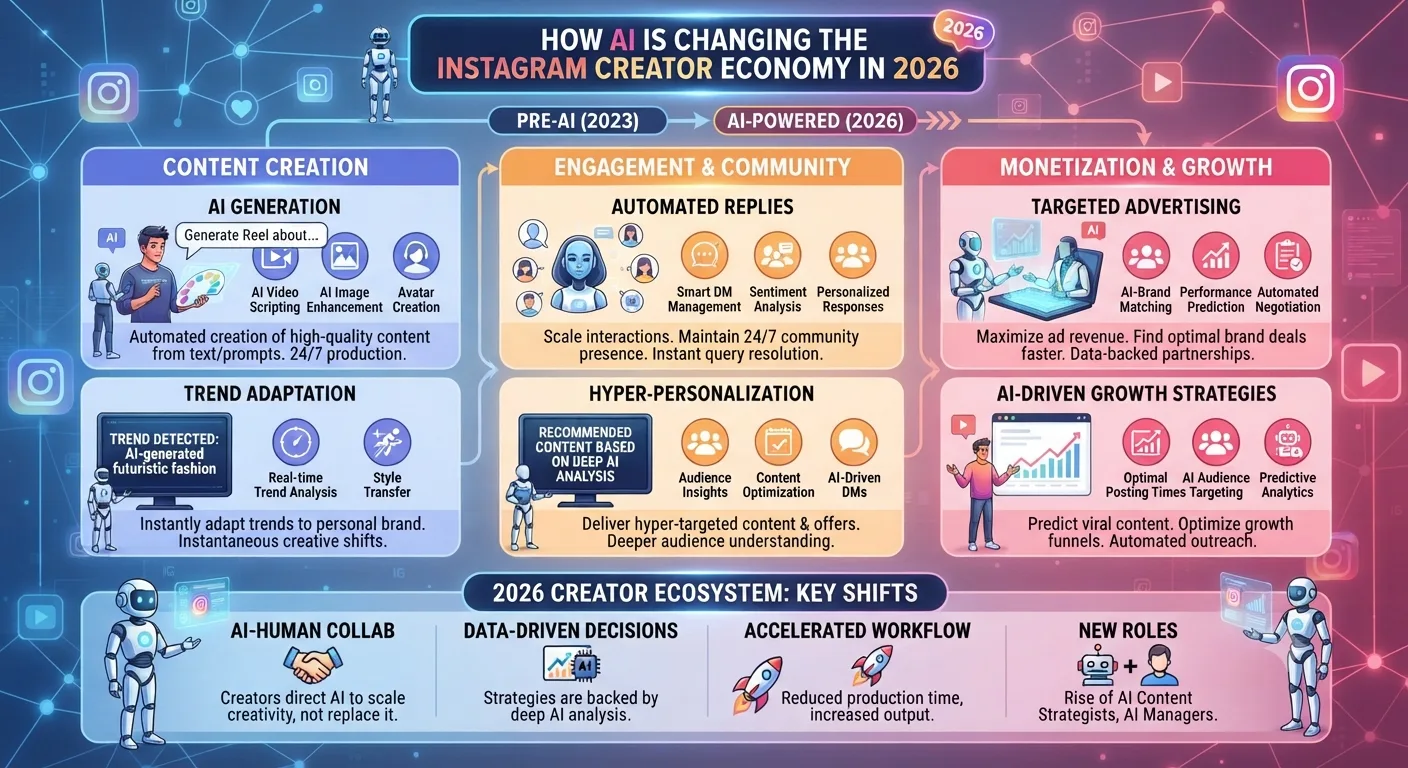
How AI Has Changed Content Production
Caption Writing
Caption writing was one of the first creator tasks to be significantly transformed by AI. Tools like Claude, ChatGPT, and purpose-built social media AI tools now produce first-draft captions that require minimal editing. The time cost of writing a month's worth of Instagram captions has dropped from several hours to under two hours for creators who have learned to prompt effectively.
This has raised the baseline quality of captions across the platform because even creators without strong writing skills can now produce polished, structured content. The competitive differentiation has shifted from writing skill to prompt skill and the ability to add genuine personal perspective to AI drafts.
Visual Content Creation
AI image generators including MidJourney, Flux, and DALL-E 3 have eliminated the need for stock photos and basic photography for a significant segment of Instagram content. Educational accounts, informational brands, and niche interest pages now generate custom visuals that were previously either expensive to commission or impossible to create without professional skills.
AI video tools including Runway, Sora, and CapCut's AI features have made short-form video creation accessible to creators without filming equipment, filming skills, or video editing experience. Faceless accounts producing entirely AI-generated video content now regularly reach millions of followers in niches including finance, history, science, and self-improvement.
Content Strategy and Planning
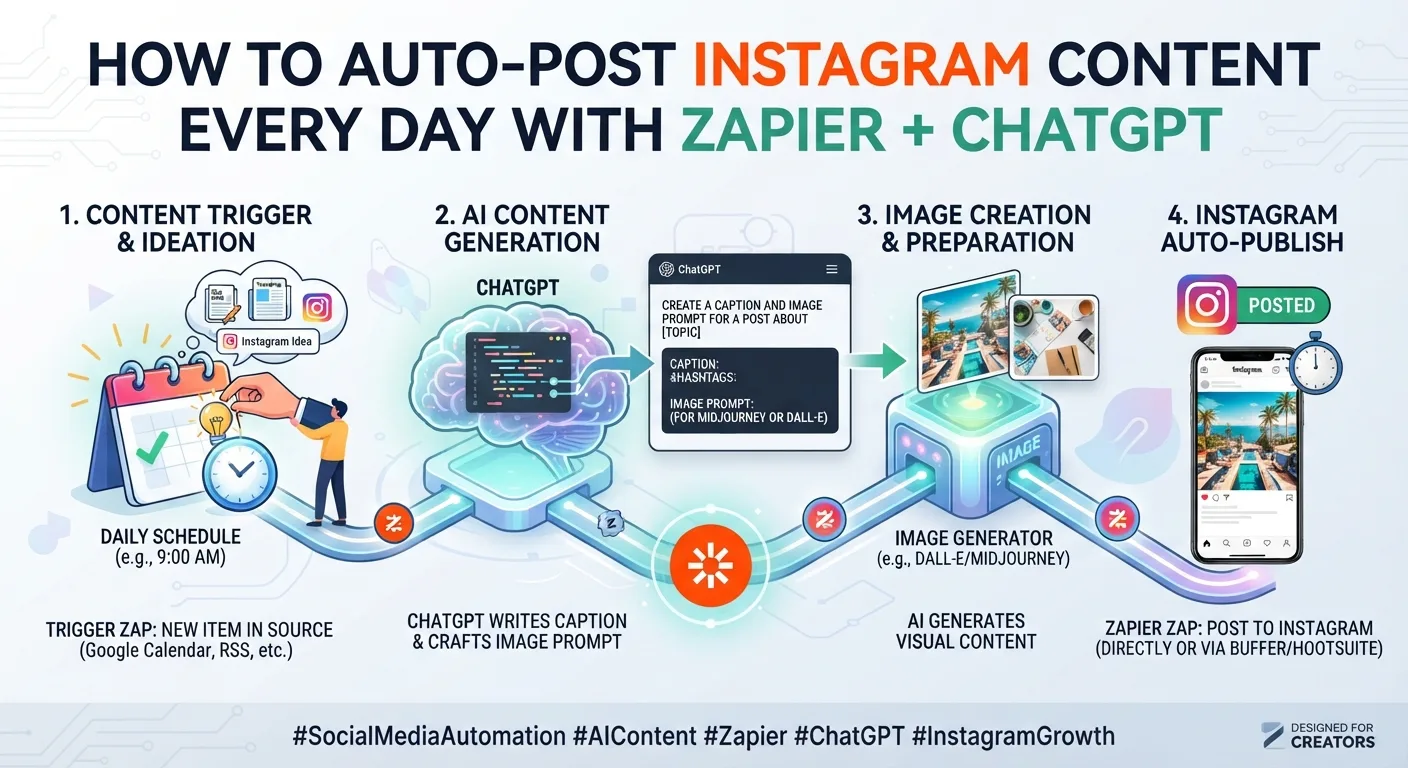
AI tools are increasingly used not just for content production but for strategic planning. Creators use ChatGPT and Claude to build content calendars, identify content gaps, analyze competitor positioning, and generate keyword-optimized content frameworks. The strategic layer that previously required marketing expertise or expensive consultants is now accessible to anyone willing to learn how to prompt an AI effectively.
The Rise of the Faceless Creator
One of the most significant structural shifts in the Instagram creator economy since 2024 has been the rapid growth of faceless accounts. These are Instagram accounts that produce high-quality content without the account owner ever appearing on camera, revealing their identity, or building a personal brand in the traditional sense.
Faceless accounts in niches like personal finance, mental health, productivity, trivia, and history have grown to hundreds of thousands and in some cases millions of followers. They rely entirely on AI-generated visuals, AI-written captions, and sometimes AI-generated voiceovers for Reels, combined with strong niche targeting and consistent publishing schedules.
This model has democratized the creator economy by removing the personal brand barrier. People who want to build an audience around a topic they are knowledgeable or passionate about can now do so without putting their face, name, or personal life on the internet. It has also increased competition in popular niches significantly, since the barrier to creating high-volume content has dropped.
What AI Cannot Replace in the Creator Economy
Despite the significant changes AI has driven, several elements of successful Instagram presence remain firmly human-dependent in 2026.
Genuine personal experience and authentic storytelling continue to outperform AI-generated equivalents for audience trust and long-term retention. The creator who shares real experiences, real mistakes, and real perspectives builds a relationship with their audience that AI-generated content cannot replicate at scale.
Community management and real-time engagement remain human tasks. Responding to comments in a way that feels genuine, hosting live sessions, and building the relationship signals that the Instagram algorithm rewards all require a human presence that AI tools support but do not replace.
Strategic judgment about which audiences to target, which content categories to own, and how to position an account distinctively in a crowded niche is a human skill that AI can assist with but not substitute for. The creators winning in 2026 are those who use AI as a production accelerator while applying strong strategic and creative judgment about what to produce and why.
What the Creator Economy Looks Like Heading Into 2027
The trends established in 2026 point toward three major developments in the near term.
Content volume will continue to increase as AI makes production faster. Instagram will respond with increasingly sophisticated quality filtering that deprioritizes pure-volume content without genuine engagement signals, raising the bar for what actually achieves meaningful reach.
AI-generated content disclosure will become more standardized. Instagram has already introduced AI content labels and is expected to expand mandatory disclosure requirements, which will create a layer of transparency that affects how audiences engage with AI-assisted content.
The most successful creators will be those who find the right balance between AI efficiency and human authenticity, using AI to handle production volume while investing their human energy in the relationship-building, strategic, and experiential elements that audiences increasingly value precisely because they cannot be generated by a machine.
Key Takeaways
- AI has reduced the production cost of quality Instagram content by 60 to 80 percent for individual creators in 2026, fundamentally changing the economics of the creator economy.
- Approximately 68 percent of creators with over 10,000 followers now use AI tools weekly in their content workflow.
- Faceless AI-assisted accounts now represent an estimated 40 percent of new Instagram launches, democratizing content creation but also increasing competition in popular niches.
- Caption writing, visual content creation, and strategic planning are the three creator tasks most significantly transformed by AI tools.
- Genuine personal experience, community engagement, and strategic judgment remain human advantages that AI cannot replicate. These are the new competitive differentiators.
- The creator economy is projected to continue growing, driven by AI-enabled production efficiency, with increasing emphasis on authentic differentiation as AI content volume rises.
Frequently Asked Questions
Is it harder or easier to grow on Instagram in 2026 compared to previous years?
It is easier to produce quality content and harder to stand out. AI has removed most production barriers, which means more people are creating more content. The increased volume makes differentiation more challenging even as the tools for creating content have improved significantly.
Can a faceless Instagram account actually make money in 2026?
Yes. Faceless accounts monetize through brand partnerships, affiliate marketing, digital product sales, and paid communities. Several faceless accounts have reported six-figure annual revenue. The monetization mechanisms are the same as personal brand accounts but require that the niche and content value proposition are strong enough to build genuine audience trust without a personal face attached.
Will Instagram audiences be able to tell if content is AI-generated?
Increasingly yes. Instagram's AI content labeling system flags some AI-generated content automatically. Audiences are also becoming more sophisticated at recognizing AI-generated imagery and writing patterns. Creators who use AI transparently and layer in genuine human perspective tend to maintain better audience trust than those who present AI content as entirely original human-created work.
What is the best AI tool to start with for an Instagram creator just getting started?
ChatGPT is the most versatile starting point because it handles content planning, caption writing, and idea generation in one interface. Most creators add specialized tools as they identify specific bottlenecks in their workflow. Starting with one generalist tool and mastering it before adding others is more effective than trying to use multiple tools simultaneously from the beginning.
Are brands and advertisers still paying the same rates to AI-assisted creator accounts?
Brand partnership rates are increasingly tied to authentic engagement metrics and audience quality rather than production style. Accounts with genuine, engaged communities command strong rates regardless of whether AI was used in production. Accounts built on AI volume without genuine community engagement see lower rates as brands have become more sophisticated at evaluating partnership value beyond surface follower counts.